




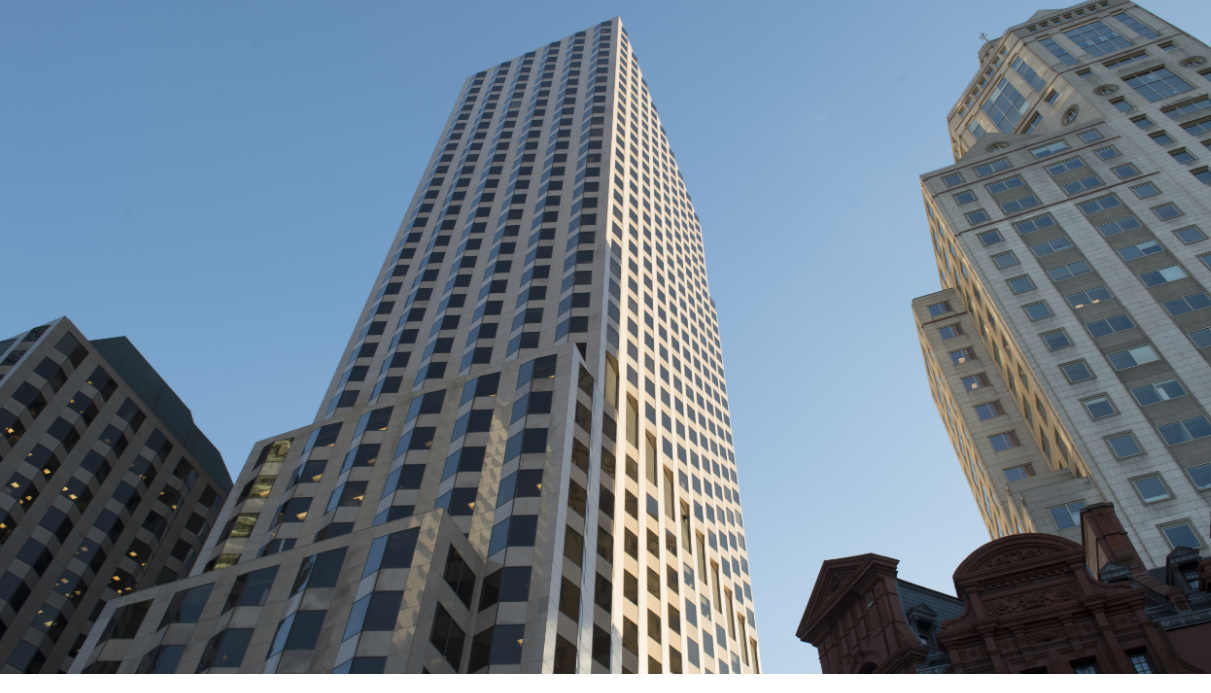
Boston-based Paradigm Properties acquired 1 CityPlace, a 38-story office tower in downtown Hartford which is 97 percent leased, for $113.3 million in the past year’s largest commercial real estate transaction.
Out-of-state investors had distinct reasons to pay top dollar for Connecticut’s biggest-ticket commercial real estate transactions of the past year.
Boston-based Paradigm Properties acquired the state’s tallest building in Hartford’s 1 CityPlace, giving it ownership of an iconic property with a high occupancy rate and long-term anchor tenant in UnitedHealthcare. BHN Assoc. of Monsey, New York, plans to tap into the influx of full-time residents and daytime workers in Hartford’s Constitution Plaza, where it acquired six buildings for $71.1 million.
Big institutional investors made their presence felt with two other top transactions. German real estate fund Deka Immobilien paid $105.5 million for Amazon’s new warehouse and distribution center in Windsor, while Healthcare Trust of America bought a large office and medical building in New Haven for $73 million.
The state’s largest office investment sale, Paradigm’s $113.3 million acquisition of 1 CityPlace, is a vote of confidence in downtown Hartford’s future, CEO Kevin McCall said. The Greenwich native has invested in commercial and multifamily properties throughout the East Coast and Midwest, but this is Paradigm’s first recent acquisition in Connecticut.
The 38-story, 885,000-square-foot CityPlace I is 97 percent occupied, including anchor tenant UnitedHealthcare, which occupies half of the building after signing a long-term lease in 2010.
“The opportunity from our point of view is there’s a lot of stability in the building,” McCall said. “We felt there was a good probability that UnitedHealthcare stays, and that’s a bet that we’re making.”
The remainder of the building is leased to a variety of tenants including law firms and Bank of America.
Part of a two-building complex, it’s connected by a 4-story, roughly 12,000-square-foot atrium to the 18-story CityPlace II tower that was sold at auction in 2014 to a group of New York investors. The atrium provides opportunities to add placemaking and amenities, McCall said, since it’s used as a cut-through for pedestrians between Asylum and Pearl streets.
But ultimately, the performance of CityPlace I will hinge on the health of the Hartford office market and the city’s attempts to foster a 24-7 downtown environment.
The University of Connecticut is building a $140 million campus scheduled to open in 2017 at the former Hartford Times property on Front Street. Multifamily development has generated hundreds of new apartments downtown, including signature projects such as Fairfield developer Bruce Becker’s conversion of the 26-story former Hartford National Bank tower into 285 apartments and 60,000 square feet of commercial space.
The infusion of college students and full-time residents could have a transformative effect upon the downtown area, McCall said.
“What’s very important to our deal was what’s going on in Hartford in general. It’s experiencing some of the same urbanization that we’re seeing in practically every other city in the country,” he said. “Hartford has been accused of having a pretty quiet downtown after 5 p.m., and that’s beginning to change.”
More Foot Traffic Sought In Constitution Plaza
Developer BHN Assoc. wants to build connections with the surrounding neighborhood after acquiring six buildings in Constitution Plaza for $71.1 million from MetLife in mid-2015.
The 664,000-square-foot portfolio contains tower space at One and 100 Constitution Plaza and low-rise buildings at 10, 248, 250 and 260 Constitution Plaza, along with a 1,743-space garage.
One anchor tenant, XL Reinsurance America, extended its 130,000-square-foot lease through 2027, while law firm Shipman & Goodwin LLP has committed to lease 115,000 square feet through 2026, said Mordy Wider, CEO of BHN Assoc.
The timing is good, with more foot traffic from new state offices opening in the neighborhood, Wider said.
More than 2,000 state Department of Revenue Services employees started moving into 450 Columbus Boulevard in July, an office building overlooking Constitution Plaza that the state acquired in 2013.
The same month, University of Connecticut trustees approved a lease renewal of the school’s Graduate Business Learning Center at 100 Constitution Plaza and an expansion to an additional two floors.
With its large outdoor plazas, BHN’s 7-acre acquisition presents opportunities to host more public events, and the owners are looking to find a restaurant to occupy 9,600 square feet with outdoor seating, Wider said.
“This part of Hartford is going to be the busiest,” Wider predicted. “Until now it was quiet, but there’s going to be a big need for restaurants and for retail.”
Next steps include new exterior lights to call attention to the tower space and possible conversion of basement space into self-storage to serve the growing downtown residential population, he said.
Institutional Investors Make Presence Felt
Big institutional investors emerged as winners in two of the other top sales of the past year.
In May, Deka Immobilien acquired the new 1.5-million-square-foot Amazon warehouse and in Windsor for $105.5 million.
Deka has been active in recent trophy investment sales in the Northeast this spring, including the $139-million purchase of the 175 Federal St. office building in Boston and its first U.S. hotel acquisition, the $270 million Marriott East Side Hotel in New York.
Scottsdale, Arizona-based Healthcare Trust of America paid $73 million in January for One Long Wharf Drive, a 287,000-square-foot medical office building that’s 99 percent occupied. The acquisition gives HTA an opportunity to expand partnerships with Yale University Health System, the company said in an announcement.
The complex has just two suites with under 3,000 square feet available, said Frank Hird, a vice president for Branford-based O,R & L Brokerage.
HTA’s strategy is to gradually convert more of the building into medical offices, Hird said. Currently, just under 50 percent of the leasable area is occupied by medical tenants. That will steadily increase as leases roll over, Hird said.
“Honestly, we have a backlog of potential medical tenants that want to be in there. We just don’t have the space for them yet,” he said.

