




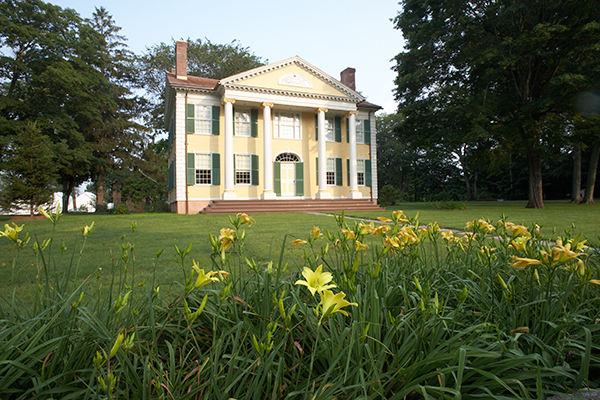
It would be hard to find any place in Connecticut where art and real estate are more intertwined than the Florence Griswold House in Old Lyme. The walls are covered with scenes painted of the landscape just outside them and every room is filled with history.
The house was built in 1817 on the banks of the Lieutenant River, not far from where it flows into the Connecticut and then Long Island Sound. Robert Harper Griswold, a ship captain, and his family moved into it in the 1840s. His daughter Florence was born on Dec. 25, 1850.
Florence, her mother, and two older sisters opened the Griswold Home School for Girls in 1878 and taught there for 14 years. After that, “Miss Florence,” as she was known, and another sister took on boarders to make ends meet.
One of those boarders was Henry Ward Ranger, a landscape artist and Tonalist from New York. Recently returned from France, he was inspired by the artist colonies he had seen there and encouraged Miss Florence to open her home to artists to create a similar colony in Connecticut.
The first artists arrived the following year. For $7 a week, they got a room, a pitcher of clear water and three meals a day. The house and Old Lyme soon became known for the many Impressionistic and Tonalist artists that flocked there, particularly between May and October, and it became one of the largest and most significant art colonies in America.
 “She was always very optimistic,” said museum marketing director Tammi Flynn. “What started out as a business arrangement turned into lifelong friendships. The artists often visited her on holidays. She was invited to their openings in New York and Boston. She was invited to President Wilson’s daughter’s wedding at the White House. And she was loved by townspeople as well.”
The pastoral surroundings of Old Lyme at the turn of the 20th century attracted painters of animals and landscapes, including Matilda Browne, William Henry Howe, Henry Rankin Poore, Edward Charles Volkert and Carleton Wiggins. Many scenes in the museum were painted on or nearby the property.
Ranger took a tradition he learned in France and brought it to the Griswold home. He painted a scene on one of the panels on the outside of a bedroom door and challenged his friend, Henry Rankin Poore, to paint a complimentary scene on the left side. Eventually every panel on every door in the house had a different scene painted on it.
Over the course of several years, Poore painted an eight-foot-long fox-hunting scene on the fireplace mantle in the kitchen. The background contains many recognizable features of Old Lyme, and many of the participants in the hunt were artists who stayed in the colony. Docents point out the many subtle, private jokes in the way some artists were depicted.
During the day, the artists painted. After dinner, they’d sing, play games and tell stories. Miss Florence would entertain them on the piano, harp or banjo. The home would come to be known as the Old Lyme Art Colony – or as residents sometimes joked, “The Hot Air Club” or “The School of Lyme.”
Many of the original windows remain in place (nine-over-nine on the first floor, 12-over-12 on the second), some with the original glass. There are pine floors throughout and the treads on the wooden stairs between the first and second floor are well-worn from use.
Presidential Visit And A Penniless Death
In the summer of 1910 future U.S. President Woodrow Wilson and his wife, artist Ellen Axson Wilson, stayed at the house. The Wilsons brought their canoe – visitors can see it today in one of the restored barns.
The museum last year purchased the last tract of land necessary to restore the original 13-acre estate. It boasts many fine trees and plants including a rare American Elm, several Cusa dogwoods and Chinese pagoda trees. Standing among the trees and restored barns, it is easy to forget Interstate 95 is just a few hundred yards away.
The many gardens on the estate are designed to bloom from May through November, Flynn said.
“Miss Florence’s garden can be characterized by what is referred to today as a ‘grandmother’s garden,’ in which masses of flowers are arranged in bordered beds close to the home,” Flynn said. “Varieties of iris, foxglove, heliotrope, phlox, cranesbill and daylilies are among the many perennials that make up the garden. There is also a bed for herbs and a few vegetables; tomatoes, beans, squash and pumpkins.’
Florence Griswold died penniless in her home, just shy of her 87th birthday, surrounded by artists and her many beloved cats. She never married or had children, but Flynn said she was a happy woman.
Today the house has been structurally reinforced and restored with mostly period – though not all original – furnishings. The bed Miss Florence was born in is in one of the first-floor bedrooms. The painted panels are still visible throughout the house.
Roughly 80,000 people visit the house, grounds and galleries each year. Flynn said she’s surprised by how often the word “magical” appears in visitor’s comments.
“They talk about the experience as a whole,” she said. “Not just the art or exhibition, not just about the house or grounds, but the whole. We feel that people really take their time here. They may come for the art, but stay for the history and grounds.”
The house and museum are open year-round for visitors and there are special events like puppet shows, exhibits and art classes for both adults and children throughout the year. More information is available on the museum’s website.

