




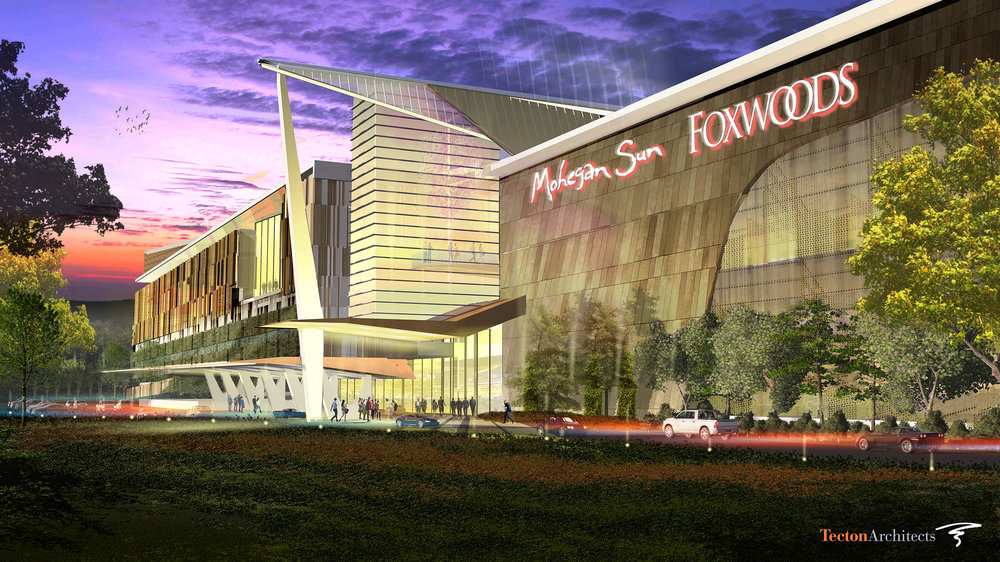
A 100,000-square-foot satellite casino proposed for a former cinema property in East Windsor is intended to protect Foxwoods’ and Mohegan Sun’s market share and their revenue-sharing payments to the state of Connecticut. Courtesy image
Politicians and tribal leaders swung mallets and took rhetorical shots at the $960 million MGM Springfield casino rising across the state border as Connecticut’s two existing casino operators began to demolish a defunct cinema complex in East Windsor this month.
After absorbing rising competition in a Northeast casino market they once had all to themselves, the owners of the rival Foxwoods and Mohegan Sun casinos began charting their first joint venture in 2015. The Mohegan and Mashantucket Pequot tribes scouted sites along the I-91 corridor for a satellite casino location designed to snag Nutmeg State gamblers who may otherwise take their business to Western Massachusetts’ first casino. MGM Springfield is scheduled to open this fall.
“We’re seeing the effects of market saturation in this region, and Foxwoods and Mohegan Sun are looking to find some way to stem the flow of cash back to Massachusetts,” said Paul DeBole, a professor of political science at Lasell College in Newton, Massachusetts. “It’s a good business strategy.”
Yet the “demolition ceremony” took place instead of a groundbreaking because the tribes still need approval from the U.S. Department of the Interior to begin construction of Connecticut’s first native American-owned casino not located on tribal lands. The two tribes and the state of Connecticut in November filed suit against the interior department after it failed to act on an amendment to decades-old Indian gaming compacts needed for the East Windsor project to get off the ground.
A Risky Bet on Expansion
The compacts approved in 1991 and 1994 granted Foxwoods and Mohegan Sun exclusive rights to casino gambling in Connecticut, in exchange for giving the state a 25 percent cut of all slot machine revenues. The same formula would apply at the East Windsor casino, a 100,000-square-foot facility that would be dwarfed by MGM’s 759,000-square-foot resort in downtown Springfield.
At the demolition ceremony, tribal leaders said they expect the legal dispute to be settled this year in their favor. But the prospect of a drawn-out court battle means a potential lost opportunity both for the tribes and their essential business partner in Hartford.
“Any delay is going to help MGM,” said Jacob Raver, an attorney for the law firm Goodwin in Boston.
Proponents of the East Windsor project attribute the delays to intense lobbying by MGM that has influenced Trump administration officials.
Ken Salazar, who was secretary of the interior in the Obama administration, argued in a March 2017 letter to Gov. Dannel Malloy that the tribes could jeopardize their existing gaming compacts. Now a partner at Boston-based law firm WilmerHale, Salazar described the 25 percent revenue share as “unusually high” and predicted the Interior Department would be tempted to reduce it if it reopened the compacts.
Such a federal review wouldn’t have been necessary had not Connecticut legislators specifically required it as part of the bill authorizing the third casino, Goodwin’s Raver noted. That may have been a strategy to ensure that the state’s existing revenue share wouldn’t be jeopardized, he said. But in the short term, it may have backfired.
“Why would they add something that could go wrong? The Connecticut legislature didn’t want to gamble at all with the current slot revenue-sharing agreement,” he said.
A federal lawsuit filed in November by the tribes and Connecticut Attorney General George Jepson argues that the amended compact was effectively approved on a technicality because Secretary of the Interior Ryan Zinke failed to act on it within 90 days.
MGM Springfield’s potential financial drain on Foxwoods and Mohegan Sun is substantial, according to recently updated market research by Clyde Barrow, a professor at University of Texas Rio Grande Valley and longtime casino researcher.
A study by Barrow’s consulting company, Pyramid Assoc. LLC, estimates that Foxwoods and Mohegan Sun could lose over $252 million in annual revenues including non-gaming dollars to new casinos in Massachusetts and upstate New York. The study, commissioned by Foxwoods and Mohegan Sun, predicted a loss of $100 million in slot revenues and 9,300 jobs.

