




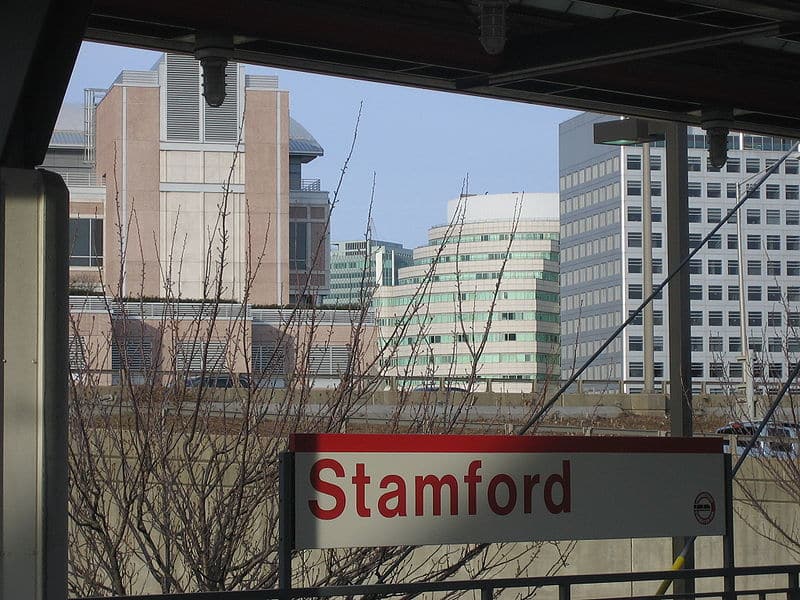
Downtown Stamford as seen from a platform at the Stamford Transportation Center. (Courtesy Photo / Public Domain / DBen)
Stamford’s economy grew along with the nation’s, and faster than the economies of other Connecticut cities, according to the city’s 2018 Comprehensive Annual Financial Report. Municipalities must publish the state-mandated, audited financial statements within six months of the June 30 end of each fiscal year.
During fiscal 2017-18, Stamford’s unemployment rate was 3.4 percent – markedly lower than the state’s 4.5 percent and the nation’s 4.2 percent, the report states.
The city has a large labor force, estimated at 70,341 workers, which was 594 more than the previous year.
“This outpaces the growth seen in other major cities such as Hartford, New Haven and Bridgeport, which have experienced a decline in their respective labor forces over the same period of time,” the report states.
Despite an uneven retail economy nationwide, the vacancy rate for retail space in Stamford was low – an estimated 5 percent to 7 percent, according to the report.
The most troubling statistic is the city’s vacancy rate for office buildings, explained in a line from the report: “The high market costs of commercial real estate in Manhattan and nearby Greenwich, and the overall cost of doing business in metropolitan New York, are making relocation of businesses to Stamford comparatively more affordable and appealing. Despite that, the office space vacancy rate in Stamford is currently approximately 28.4 percent.”
It’s likely closer to 30 percent, said Jim Fagan, senior managing director with Cushman & Wakefield, a commercial real estate services provider with a Stamford office.
“It’s the highest in the country,” Fagan said. “It’s worrisome to a point where the best buildings are doing just OK, and the worst buildings have a real problem.”
There are several reasons for it, he said. One is technology.
“Stamford used to be a market of financial traders,” Fagan said. “The big trading floors at what used to be UBS and RBS have been transformed into little black boxes in somebody’s server room — computers doing what is called algorithmic trading.”

