




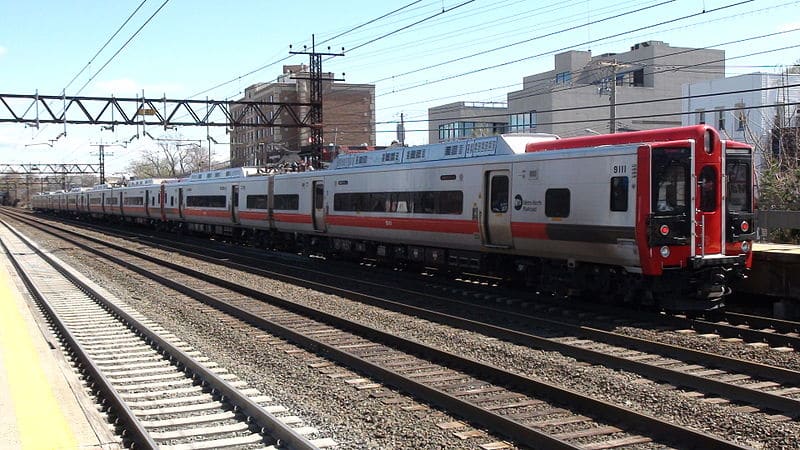
Photo courtesy of Wikimedia user 209harrison / Public domain
A proposal to establish a state-run infrastructure bank is sparking widespread debate among lawmakers, trade groups and other stakeholders trying to determine the best course for Connecticut’s struggling economy.
Introduced by state Sen. Alex Bergstein, D-Greenwich, who is also chairwoman of the legislature’s Banking Committee, the bill would establish a quasi-public Connecticut Infrastructure Bank to assist with financing for projects including, but not limited to highways, bridges, railroads, waterways, ports and airports.
Bergstein has suggested the bank could help fund Gov. Ned Lamont’s 30-30-30 high speed rail project to create 30-minute train times between Hartford, New Haven, Stamford and New York City.
The public-private partnership would leverage public funds with private investment capital to multiply every public dollar five to 10 times. There are also several other pending bills proposing state-run banks and feasibility studies to examine the concept.
Advocates have called the infrastructure bill a necessity to address struggles in Connecticut. Like other states, Connecticut’s infrastructure is in dire need of repair, with 57 percent of its public roads in poor condition and 338 bridges rated as structurally deficient.
U.S. News and World Report recently ranked Connecticut as the 41st-worst state in the U.S. when it comes infrastructure quality.
“It is not hard to understand why North Dakota established the first state-owned bank in the nation back in 1919,” state Rep. Susan Johnson, D-Windham, said in prepared testimony for a recent public hearing on the infrastructure bank bill. “Our Green Bank has been able to leverage limited public funds to attract multiples of private capital investment while reinvesting public funds over time.”

Connecticut’s infrastructure is in dire need of repair, with 57 percent of its public roads in poor condition and 338 bridges rated as structurally deficient.
Green Bank Could Offer Model
Like the proposed infrastructure bank, the Green Bank is a public-private partnership development financial institution, specifically tasked with mobilizing private capital investment and directing it towards the deployment of “clean energy” resources.
Since its inception, the Green Bank has mobilized $1.5 billion of investment into Connecticut’s clean energy economy at a six to one leverage ratio of private to public funds.
The bank has supported the creation of over 16,500 direct, indirect and induced jobs; reduced the energy burden on over 35,000 families and businesses, deployed nearly 330 megawatts of clean energy and helped reduce over 5.3 million tons of CO2 emissions over the life of the projects. It has also generated over $75 million in individual income, corporate and sales tax revenues to the state through 2018.
Despite the Green Bank’s success, past studies by the Connecticut Department of Banking and Massachusetts legislature have panned previously proposed state-run banks.
“While the proponent’s intent of HB 5970 is laudable, community banks throughout Connecticut are some of the best capitalized in the country – and are ready to lend,” said Tom Mongellow, executive vice president and treasurer at the Connecticut Bankers Association. “They have diverse and affordable product offerings for both businesses and consumers. A state-run bank would only compete for community bank business in an increasingly competitive marketplace.”
Not all with a banking background were opposed to a state-run bank.
It is time for the state and the rest of the U.S. to catch up with other countries and continents like Europe and China and invest more into infrastructure, said Suneel Kamlani, a Connecticut resident and the former CEO of RBS Markets.
“Across the U.S., states account for about 75 percent of all public infrastructure spending,” he said. “This is largely funded through federal grants, gas taxes, user fees and the issuance of municipal bonds. Unlike other nations, which actively utilize private capital for infrastructure projects, in the U.S., the public sector still funds the majority of it. With tight fiscal budgets and escalating needs, this is no longer sustainable.”

Gov. Ned Lamont has proposed a big investment in high-speed rail to shrink travel times between the state’s biggest business centers down to 30 minutes. Photo courtesy of Wikimedia user Jehochman / CC BY-SA 4.0
Transportation Stakeholders Split
Like members of the banking sector, stakeholders in the transportation industry are divided on the proposed infrastructure bank.
Groups including the Connecticut Construction Industries Association, Capitol Region Council of Governments, Transit for Connecticut, the Connecticut Association for Community Transportation and the Regional Plan Association all came out in support of the infrastructure bank bill.
Fixing the Nutmeg State’s transportation deficiencies is imperative and cannot be done without new, creative solutions, said Melissa Kaplan-Macey, vice president and Connecticut director for the RPA.
But Jennifer Shafer of No Tolls Connecticut is against the bank because she thinks it could lead to excess spending.
“This bank will create more debt and liabilities for the people of Connecticut. Connecticut will then see more middle class and working families flee the state,” she said. “We cannot afford a 30-30-30 high speed railway that would be financed by this infrastructure bank and the tolling of Connecticut tax payers.”
Joseph Scully, president of the Motor Transport Association of Connecticut, said the organization was not necessarily opposed to the idea of an infrastructure bank, but that more study would be needed to look at some of the potential logistical issues.
For instance, guidance from the Federal Highway Administration on state infrastructure banks explains that they are intended to be revolving funds in order to provide credit assistance such as loans, loan guarantees, lines of credit and more for local transportation projects.
But since the funds are revolving, repaid loans go back into the fund for further lending, potentially making it tough for municipalities to repay the funds, he said.
“Municipalities are heavily dependent on state aid for many things, including some infrastructure related issues,” Scully said. “When town-aid road funds were withheld during the Malloy administration, municipalities struggled to adjust. If municipalities can’t handle a reduction in state aid such as town-aid road funds, how are they going to be able to handle the cost of a major infrastructure project, plus interest to be paid back to the bank?”

