




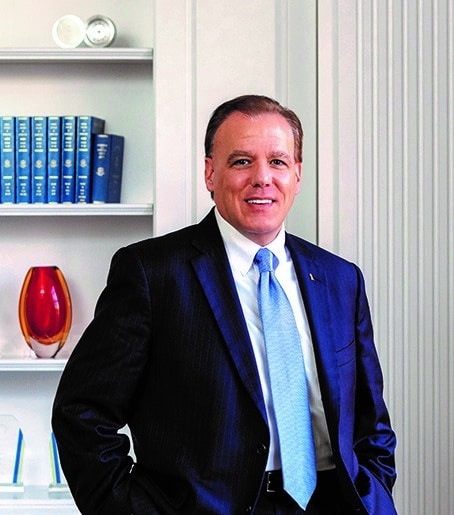
Martin Morgado. Image courtesy of Savings Bank of Danbury.
Martin Morgado
President and CEO, Savings Bank of Danbury
Age: 53
Experience: 32 Years
Savings Bank of Danbury is celebrating its 170th year in business and is also the oldest existing business in Danbury today. Current President and CEO Martin Morgado credits these achievements to the organization’s constant focus on its core mission and vision of “people serving people,” meeting the needs of the bank’s customers today and tomorrow and keeping its employees engaged.
Morgado has been in banking for more than three decades. He was first hired at Centerbank in Waterbury, where he completed a management training program focused on commercial lending and branch management. Morgado then joined Nutmeg Federal Savings and Loan in Danbury, where he held positions in branch management and lending, before arriving at Savings Bank of Danbury.
Morgado has held numerous positions with the bank including head of retail lending, and the Saint Michael’s alumni helped launch the bank’s profitable mortgage banking division. He was chief operating officer before being appointed as president and CEO in 2016.
Q: What parts of Connecticut’s economy are starting to look better and what still needs improvement?
A: There are bright spots in the Connecticut economy, including many job openings and an increase in wage growth. In fact, Connecticut added more than 23,000 jobs in 2018 and projections are for strong growth to continue through 2019. Unfortunately, many of these jobs will go unfilled in part due to lack of workforce training, the threat of higher taxes and the ensuing negative impact on individuals and businesses.
Connecticut is still recovering from the economic downturn of 2008 and 2009, and the improvement in the economy is tempered by challenges, which include a contracting and aging population, increased government regulations and an exodus from the state of younger residents and retirees.
Stabilizing the state’s fiscal condition would in turn create an environment that becomes more appealing to businesses and residents and ultimately leads to economic growth. We would also like to see more support from the state as it relates to fostering entrepreneurship, construction and multifamily housing industries.
Q: Most community banks have been reporting fierce deposit pressure. Has this been the case in your market? What strategies are you employing to bring in new deposits?
A: We have experienced deposit pressure over the past year and have implemented strategies to actively expand the bank’s customer base and increase relationships.
First, we are selectively increasing deposit rates as appropriate and have implemented customer acquisition programs, cross-selling and strengthening customer relationships. To support this strategy, we recently implemented a relationship banking retail model, where branch staff is authorized to go out and meet customers and prospects where they are instead of relying on the old model where folks walked into the branch. It’s a much more proactive approach and we see this model gaining traction.
As branch traffic decreases due to increased mobile and digital banking channel usage, compounded by lower population growth in Connecticut, it is imperative for us to make sure that we are meeting customers where they are but also meeting their evolving needs which we know are changing.
Q: Your bank saw a 19 percent increase in mobile deposits in 2017. Have there been any developments on this front? How is your board looking at fintech solutions as it fits into your strategic plan moving forward?
A: We continue to see higher usage of digital channels including mobile deposits in the conducting of business. Our team members monitor innovation and we identify areas where we can improve. We continually monitor customer feedback with a goal of achieving a balance of high customer service experience with innovation. We want to appeal to prospective customers while being certain that we don’t overwhelm our existing base.
Regarding fintech solutions, we always seek ways to stay ahead of the curve from a product and service innovation perspective. We are aware of the many fintech solutions out there and some are really good ideas but again, it’s about balance. We seek improvements that will be authentic to who we are, rather than simply jumping on a bandwagon.
Q: Savings Bank of Danbury is preparing to celebrate its 170th anniversary. What does the bank need to do to ensure it keeps thriving for another 170 years?
A: The bank has remained relevant by continually adapting to meet our customer’s needs and to remain a vital part of the communities we serve. When the bank started in 1849, embracing the mutual bank philosophy, it helped individuals and families build their finances. During the 20th century the bank pivoted to help emerging entrepreneurs, professionals and small businesses seeking lending opportunities to help them grow.
Moving into the 21st century, the bank re-evaluated its operating model to address customer’s needs that came with the advent of the internet, digital banking, declining branch activity, cyber-security and increased regulations. The next 170 years seems like a long time from now, but I am confident that keeping a clear focus on our original mission and evolving to meet the financial needs of the people that we serve will go a long way to getting us there.
Morgado’s Five Gems in Savings Bank of Danbury’s Footprint:
- The beauty of Candlewood Lake.
- Stamford’s waterfront and its vibrant communities.
- The Palace Theater in Waterbury, for being the area’s center for performing arts for a century.
- CityCenter Danbury for transforming downtown Danbury into a vibrant and energetic place.
- The Charles Ives House for its part in Danbury history and connection to the bank’s birthplace.

