




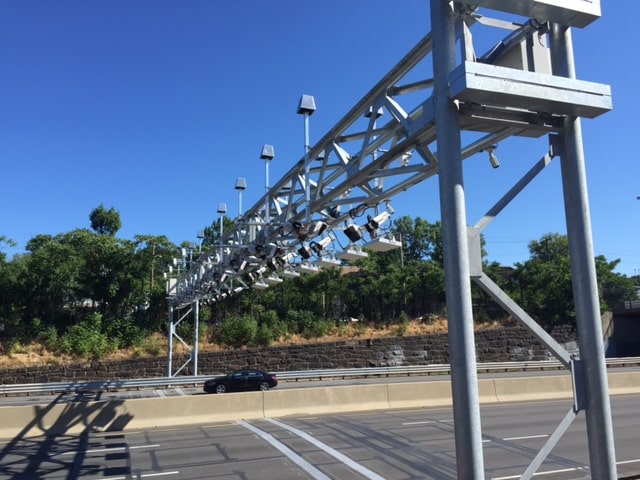
Connecticut lawmakers and Gov. Ned Lamont are trying to craft a complicated plan in the waning days of the legislative session that could lead to electronic tolls on a handful of highways, a process that’s been made more challenging by the need to ultimately obtain federal approval.
Democratic House Speaker Joe Aresimowicz of Berlin, a toll proponent, suggested Monday that the General Assembly might return to Hartford for a special legislative session to vote on tolls, considering talks are still going on between lawmakers, Lamont’s administration and the Federal Highway Administration. The regular session ends June 5.
“It is an incredibly complex bill to write,” he said. “This is the type of issue I’d like to get done before we adjourn. But I wouldn’t be opposed to coming back into special session too. It’s that important to the state.”
The plan currently calls for roughly 50 tolls on busy Interstates 84, 91, 95 and Route 15, in hopes of generating an estimated $928 million in annual gross revenues for transportation improvements. The push comes decades after Connecticut removed the state’s old toll booths in the mid-1980s following a deadly toll plaza crash.
Connecticut’s approach to resurrecting tolls is relatively unique. Most other states installed tolls years ago for “greenfield projects,” new roads, bridges or tunnels that used the revenue to cover specific costs and later generate additional money for ongoing maintenance. Some states have installed limited electronic tolls on a lane or two, creating special expressways to address traffic congestion on portions of the roadway. In contrast, Connecticut is looking at tolls on existing highways statewide.
“I’m not aware that anybody else has done it this way. It’s a little bit like a unicorn,” said Patrick Jones, a toll supporter and executive director and CEO of the International Bridge, Tunnel and Turnpike Association, referring to Connecticut’s approach to implementing tolls.
Federal law over the years has mostly barred the addition of tolls to existing interstates. But Connecticut is seeking to do just that under the FHWA’s Value Pricing Pilot Program, which allows tolling and other pricing mechanisms to manage congestion on highways, typically charging higher rates during busy commuting times in hopes of encouraging drivers to vary their driving times and ultimately ease traffic. Connecticut holds one of the program’s 15 slots. The Highway Administration has been providing technical assistance to the Connecticut Department of Transportation on a proposal that meets the program’s requirements for reducing congestion.
Stamford Sen. Carlo Leone, the Transportation Committee co-chair, said state officials have been “keeping the line of communications open with the feds” as they continue negotiating the tolling bill.
The lack of a final bill so late in the legislative session and details about hot-button issues such as the exact number and location of tolling gantries and how much of a discount Connecticut drivers might receive, has helped to fuel criticism about the process.
The governor originally supported only tolling big trucks like in Rhode Island. He has since put his support behind broad-based tolling and recently sent a letter to the General Assembly seeking support of tolls and expressing willingness to compromise on a plan.
Lamont promised that peak toll rates would be set at 4.4 cents per mile, plus-or-minus 1.3 cents, to “allow the DOT the flexibility to ensure ultimately approval by the federal DOT.” He said the rates would be frozen for three years and there would be various discounts.
Opponents of the toll plans held a rally at the state Capitol over the weekend that was attended by about 1,500 people.
“Every day we hear a new scheme, as they’re wheeling and dealing and trying to cobble together votes from the Democrat majority,” Rep. Laura Devlin of Fairfield, the top House Republican on the Transportation Committee, said at the rally.
In a fiery speech, Senate Republican Leader Len Fasano of North Haven said that toll proponents are “talking about passing a plan that doesn’t exist” and then figuring out the details later.

