




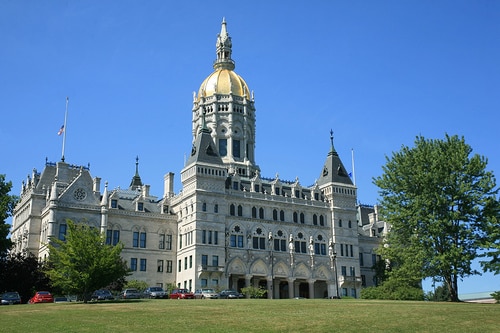
File photo
Connecticut lawmakers began the new legislative session in January with a weighty to-do list. With adjournment just days away, some of the key items on that list remain unfinished.
Chief among them is a new two-year state budget.
House Speaker Joe Aresimowicz of Berlin said he’s hopeful a “handshake deal” reached last week between Democratic legislative leaders and Gov. Ned Lamont will come up for a vote Monday. The General Assembly’s regular session adjourns at midnight on Wednesday, although lawmakers might pass a resolution to extend the deadline.
Some other major issues, including electronic tolls and recreational marijuana legalization, will likely have to wait until a special legislative session or possibly longer.
Lamont and the Democrats announced on May 30 they had reached an agreement on a roughly $40 billion, two-year tax and spending plan they say closes a projected two-year, $3.7 billion gap.
While some details have been revealed – Lamont said the plan doesn’t include a capital gains tax increase or higher personal income tax rates – as of Saturday, rank-and-file lawmakers still had not met with their leaders to go over the finer points, including how much state aid their cities and towns can expect.
Aresimowicz acknowledged Saturday that “it’s taking a lot longer” than expected to actually transform the framework into budget documents. The deal was reached without the Republicans, the minority party in the General Assembly. He said he was hopeful all lawmakers will be able to get more information over the weekend.
Some parts of the deal are receiving last-minute pushback, including a proposal that would impose income taxes on certain limited liability companies that don’t pay the corporation tax. Proponents say taxing these so-called “pass-through” entities will impact wealthy business owners, a claim contested by business groups.
“Most small business are middle-income earners, and the vast majority of their businesses happen to be structured as pass-throughs,” said Andrew Markowski, state director of the National Federation of Independent Business in Connecticut. “So, any increase in this tax impacts them in a very negative way because they make plans based on their predicted costs.”
While Lamont had urged lawmakers to pass a tolling bill before the regular session adjourns, days after urging the General Assembly to focus on the budget, it appears likely the contentious issue will be addressed in a special session.
Aresimowicz last week said it was “highly unlikely” there would be a vote, given the anticipated lengthy debate.
Earlier this month, Lamont released a working draft of a 24-page transportation bill he said provides a “solid foundation from which to build upon” during the special session. It calls for no more than 50 tolling gantries on Interstates 84, 91, 95 and parts of Route 15 and the creation of a new Connecticut Transportation Commission, which would be charged with setting toll rates during peak and off-peak times and for different types of vehicles.

