




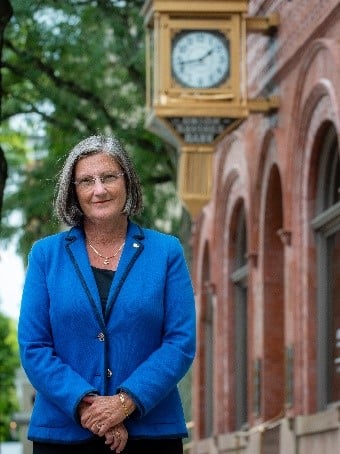
Cynthia Merkle
Chair, Connecticut Bankers Association; President and CEO, Union Savings Bank
Age: 62
Industry experience: 44 years
Cynthia Merkle joined the Connecticut banking world only six and a half years ago, and in that time has had some notable accomplishments. She became Union Savings Bank’s first woman president in 2014 and first woman CEO in 2015, and last month she became the first woman chair in the 120-year history of the Connecticut Bankers Association. Merkle relocated from Massachusetts after spending more than 20 years at Eastern Bank, and she said the welcoming community in Connecticut made a difference to her. Some of her priorities for the CBA include recruiting workers into the banking industry, privacy legislation and banking in the cannabis industry.
Q: What reaction have you received as the CBA’s first woman chair?
A: I’ve gotten a lot of positive feedback in a very short period of time. I’m actually hearing from people I haven’t heard from in years who are in the New England area and somehow got the news. It’s names from my past, and it’s always nice to reconnect. I’m the first female president and CEO of Union Savings Bank as well, so I guess I have a lot of firsts. It’s been really fun to hear the well wishes, and I think a lot of what I’ve heard is that people have enjoyed hearing about my background.
Q: What was your first role in banking?
A: I went to work for a bank in Providence, Rhode Island, as a teller for about a year and started going back to school nights at Bryant College to get my bachelor’s. At some point I was fortunate my father said, “Well maybe it’s time you go back full-time and finish up,” and that’s what I did. It was that bank where I had worked as a teller that hired me when I graduated from Bryant into their management training program. I worked in the branches for quite a while. I then had an opportunity provided to me to go over to mortgage and learn the mortgage business at that bank. I didn’t really know much about Fannie Mae or Freddie Mac back then, but I took the opportunity, and I ended up spending I think over 10 years in mortgage banking at one or two different banks.
Q: How do you recruit people today into the banking industry?
A: Banking has changed so much. I hold town hall meetings with my own team here at Union Savings Bank three times a year. At my most recent series of town hall meetings, I stood in front of them with my mobile phone and said, “I never thought I would say I’m working for a technology company and not a bank.” I really work hard to promote what banking is today and all the different kinds of careers.
I think banking got a bad rap after the major crash in 2008. Banking was no longer being perceived as a noble profession or a glitzy profession. So, I start with my own team here at Union Savings Bank, because they are the best recruiters that I can have. If they’re happy and they’re established here and they’re getting opportunities, they go out and spread the word. They’re the biggest source that we have for bringing in new employees to this bank.
Q: What are some of your priorities as chair of the CBA?
A: There’s a lot of legislative work both in Hartford as well as in Washington that impacts the banking industry. We’re looking at what’s happening with privacy. There are various states that have passed privacy regulations. It seems like every state now is trying to go it alone, so they’re coming up with all different versions of privacy rules, and that’s a problem because not all of our customers live in Connecticut. Customers move. We’re really working hard in Washington to see if there can be one consistent privacy bill that would serve all of the states.
Another issue is cannabis and how to bank cannabis medical facilities. States are passing laws that allow these facilities and industries to grow, yet at the federal level there still has not been clearance to do that. So, there’s a conflict there. The CBA and the American Bankers Association have been very active at the federal level and the state level to see if there can be some common ground.
Q: What challenges does the Connecticut banking industry face?
A: We’re facing a population drain in Connecticut. People are leaving, so it’s hard to grow new customers. That is a major challenge for all of the banks. And that also goes back to the talent, the employees and who you hire. Unfortunately, a lot of young people are going off to college, and they’re not coming back. There’s a challenge to hire young people, and so it’s kind of a double-edged sword. It’s really a population and talent drain.
Q: What initiatives does the CBA have to address that?
A: We’ve been working with the commissioner’s office at the Department of Banking, and working on a formalized internship program so we can get to some of these people in the colleges and partner them with the education that they need and then with banks in the hope that if they enjoy it and they’ve learned, they’ll want to stay. They’ll have the opportunity for that first out-of-college or out-of-high school job.
I give the Department of Banking a lot of credit because they really have been at the forefront of recognizing the issue and trying to do something with the banks. The CBA also has a fabulous school of finance and management. It’s a two-year program, so banks can avail themselves of that and enroll some of their junior-level personnel into it. It gives the student the opportunity to learn about balance sheets, marketing plans, really a holistic view of a bank. Many of the people who have graduated from that program from a variety of banks have gone on and done very well.
Merkle’s Five Favorite Scenic Hikes
- The summit of Mount Vesuvius, Italy
- The Path of the Gods, Amalfi Coast, Italy
- 49 Palms Oasis, Joshua Tree, CA
- Indian Canyon, Palm Springs, CA
- Gateway Loop, McDowell Sonoran Preserve, Scottsdale, AZ

