




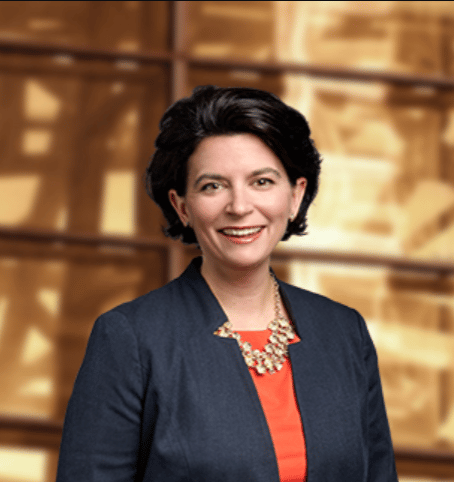
Kathleen M. Mylod
Partner, Shipman & Goodwin LLP
Age: 44
Industry experience: 15 years
After joining a women’s professional networking organization to help her make contacts in the legal industry across the nation, Kathleen Mylod is taking over a leadership role. Mylod is president-elect of CREW CT, the 100-member Connecticut chapter of Commercial Real Estate Women. In her day job, Mylod is a partner at Hartford-based Shipman & Goodwin LLP, where she advises clients including private equity and sovereign wealth funds, insurance companies and banks on debt and equity investments in commercial real estate. She joined the firm in 2015 after a decade with Dechert LLP, a national law firm.
Q: What sort of investments and risk profiles are your clients seeking in commercial real estate right now?
A: I have a real diversity among my clients, and where they make their lending side investments varies. One client is a large New York-based consortium, and they tend to play in the primary markets and big cities. The investments will vary from a retail development to multifamily to office and even some light industrial. I have another client that makes much smaller investments, and they are willing to lend at a higher risk profile than an insurance company, so they are finding their deals in the secondary and tertiary markets such as North Carolina and the Midwest and Mid-Atlantic. What I’m seeing for most of these clients and others is the modern office building that is fully leased with five- or 10-year terms left on the major leases are the safest bets in this market, where you don’t have to put a lot of improvements into the property and you have stability in your revenues. From an underwriting perspective, hospitality is really challenging not only because there are so many moving pieces, but also understanding if the hotel is franchised and the unpredictability that can come with that market. With people waiting for the downturn to come, luxury vacations will be cut.
Q: What’s their outlook for retail properties?
A: There’s so much to that question. Retail is a challenge because of the online components and the shopping centers are not what people want anymore, even the outdoor centers that were a thing, so I think that lenders are starting off wanting to have more hands-on knowledge of what’s going on with the retail properties: setting up more reserves, more structures in place so if there’s an issue with a tenant that can interrupt cash flow, retail can be more structured. But on the flip side, it still has been very much a borrower’s market. Lenders in order to get transactions will accommodate requests to be softer in that structure. It’s a balancing act.
Q: How can deals accomplish that?
A: They’re more structured in terms of the lender having better access to the cash. They might say, “OK, if you’re not you’re not yielding ‘X’ amount, we’re going to start tapping the excess cash so we can save for a rainy day,” or requiring a leasing reserve funded with ‘X’ dollars at loan origination and has to be topped off if a tenant does walk, so there’s money to carry the property while there’s a vacancy.
Q: How long have you been active in CREW Connecticut?
A: I joined CREW five or six years ago at my old law firm. When I came back to Shipman & Goodwin with the intent of working more with people in my own backyard, CREW became materially important to me. This is a networking platform and a way to get to know people in the Hartford area and Fairfield County, which is where I envisioned my practice going. Ironically, I am not doing much work in Connecticut and my path took a different route with the clients I attract and retain. The fact that CREW is a national network and there are chapters in all 50 states, for somebody who has a national practice and sits in Hartford at a regional law firm, it is indispensable for me to have people who I can call in other jurisdictions. When my clients retain me, they can bring me transactions in other jursidictions and I can find the right people. CREW is the first place I go.
Q: Does CREW weigh in on public policy issues affecting the commercial real estate industry?
A: What we tend to do is not necessarily weigh in on policy. We provide a forum for our members and the public to come together and unpack those issues. There’s lots of buzz everywhere about opportunity zones. That’s something that CREW has had some programming on in 2019 and it continues to be of interest to our members.
Q: How do you rate women’s rate of advancement in the industry?
A: That’s a great question and it’s a loaded question. I can’t say definitely where I’ve seen measurable progress and our local chapter doesn’t track that. There’s more awareness of continuing to advocate for oneself, not just in the stereotypical breaking the glass ceiling, but how to be primed to have those challenging conversations to get the raise or the promotion and to be appropriately assertive about it without being apologetic. Women are sharing stories with other women where they’ve had missed opportunities and sharing that information with others can be empowering.
Q: Working in downtown Hartford, how would you characterize the city’s current economic climate?
A: There definitely has been a shift in the past 10 years with the UConn downtown campus development and the Hartford 21 tower. How that plays into long-term sustainability for the city at large and areas outside the downtown, I don’t have enough knowledge. I’d certainly like to see the area around Dunkin’ Donuts Park continue to be developed. Hartford has, I sense, an effort to retain talent and youth, these innovation hotbeds. Stanley Black & Decker has one right in my building.
Mylod’s Five Favorite U.S. Vacation Destinations:
- Miami Beach
- Coronado Island, California
- Seattle
- Lake Placid, New York
- Spring Lake, New Jersey

