




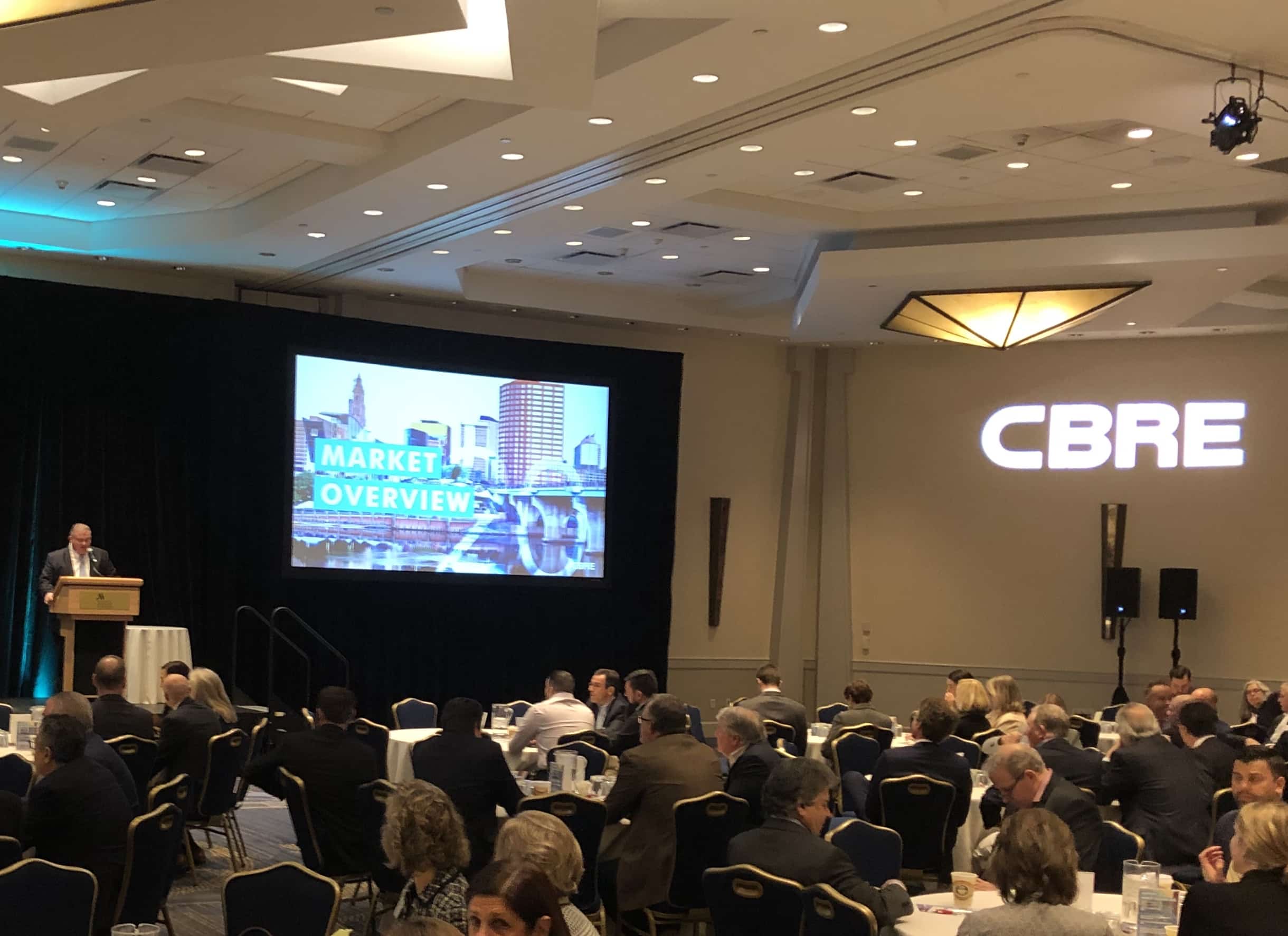
Industrial real estate will continue to attract strong demand while a potential tug-of-war looms between downtown Hartford and suburban office properties in 2020, commercial real estate brokers said at a market outlook forum sponsored by CBRE in Hartford.
Ecommerce, food and beverage and home improvement tenants helped the Greater Hartford industrial market register positive absorption in seven of the eight past years, adding 6.5 million square feet before retreating by 305,000 square feet in 2019, said Kyle Roberts, vice president at CBRE.
“Be calm. Rest easy. We don’t believe this is any sign of a weakening industrial market or a sign of negativity to come,” Roberts said at Friday’s forum at the Hartford Marriott Downtown.
Industrial vacancy rates range from 5.4 percent in the Hartford west submarket to 10.7 percent in the Hartford east region.
Food industry tenants accounted for many of the largest transactions in 2018, as Stop & Shop parent Royal Ahold leased 975,000 square feet of warehouse space from Winstanley Enterprises at the former J.C. Penney warehouse in Manchester. Sardilli Produce and Dairy paid $9.5 million for a 215,000-square-foot former Konica Minolta warehouse at 550 Marshall Phelps Road in Windsor.
Up to five lease transactions topping 200,000 square feet could be signed in 2020, Roberts predicted, amid demand for “reverse logistics” space to process ecommerce returns.
The office market showed little momentum in 2018, with Hartford’s 9.7 million-square-foot market registering 162,000 square feet of negative absorption and a 17 percent vacancy rate. All four suburban Hartford submarkets tracked by CBRE declined, with a total 535,000 square feet of negative absorption.
Asking rents range from $21.19 per square foot on a gross basis in the Hartford west suburban market to $22.02 in the Hartford central business district.
The sluggish performance partly reflects corporate mergers as well as companies’ more efficient use of workspaces, said John McCormick, executive vice president at CBRE. But eight tenants currently scouting space could commit to 250,000 square feet by mid-year, McCormick said.
Downtown Hartford properties could benefit from the resurgence of urban workspaces, but at the expense of suburban campuses.
“What we’re hearing from large and small employers alike is their workplace strategy has to include an urban strategy or at minimum, a walkable environment,” McCormick said. “As an owner in the suburbs, you have to be concerned about the migration to the capital city.”
The 3.6 million-square-foot north suburban market has the region’s highest vacancy rates at 31.8 percent and average asking rents of $16.76, while the western suburban market had the strongest performance with vacancy rate of 13.6 percent and average asking gross rents of $21.19 per square foot.
Investment sales activity increased from previous years with 26 buildings sold to a mix of local, national and international buyers. Some of the recent transactions have been at attractive prices enabling the new owners to update infrastructure and amenity packages, potentially putting longer-term owners at a competitive disadvantage, said Patrick Mulready, CBRE senior vice president.

