




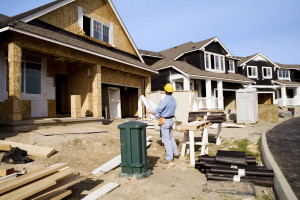
Gov. Ned Lamont wants to give Connecticut cities and towns the power to adopt their own “green building codes” that could require designs with enhanced energy efficiency and sustainability.
The changes, unveiled last week as part of Lamont’s budget package submitted to the General Assembly, would apply to all new commercial and residential construction. Building industry representatives warn that it could increase development costs and drive up home prices, and make it harder for contractors to comply with a patchwork of different regulations in the state’s 169 communities.
“One of the few things we’ve done pretty well in the state of Connecticut has been keeping a uniform building code with the state rather than having 169 fiefdoms with their own rules,” said Bob Wiedenmann Jr., president of Wallingford-based Sunwood Development Corp. “Even small builders work in various jurisdictions, and to have to handle all of the things each local building department thinks is important in their town baffles me.”
‘A Seismic Shift’
The Rocky Hill-based Home Builders & Remodelers Association of Connecticut is planning to lobby against the proposal, which will be reviewed by the assembly’s Committee on Energy and Technology, arguing that will drive up housing costs and discourage the creation of affordable housing.
“This would be a seismic shift in that it would get away from decades of precedent,” said Jim Perras, CEO of HBRA CT. “Since 1971, the code has allowed for a natural progression of more resilient and energy-efficient homes, and there is no need for deviation from the current regulatory regime.”
Perras cited a 2019 study by the National Association of Home Builders that every $1,000 increase in home prices puts home ownership out of reach for an additional 127,560 households nationwide. And he pointed to Massachusetts’ experience with its so-called “stretch code,” a voluntary appendix to the state building energy code, which has been blamed for discouraging affordable housing production in the nearly 280 communities that have adopted it since 2009.
“Every dollar matters when it comes to affordability, especially in a state like ours where extreme socioeconomic stratification occurs,” Perras said.
Alternative Proposed
As an alternative, the group supports a one-time state income tax credit up to $5,000 for buyers of energy-efficient new homes. The credit would apply to residences with a Home Energy Rating System (HERS) index rating of 60 or above. The index, which was developed by the nonprofit Residential Services Energy Network, ranks homes from 0 to 150 based upon energy performance, with a 0 score representing a Net Zero home that produces as much energy as it consumes.
A bill establishing the tax credit failed to move forward in the previous legislative session, Perras said.
An architect and chair of the Connecticut Green Building Council said the group supports Lamont’s proposal.
“We feel that it is a good first step in the right direction. We believe that making it a voluntary provision that municipalities can adopt will encourage its usage throughout the state,” said Ross Spiegel, specifications coordinator at SLAM Collaborative in Glastonbury.
A Change in Power Dynamic
The governor’s legislation, known as An Act Concerning the Establishment of High Performance Green Building Standards, also could give more power to laypeople and climate activists instead of the building industry that currently has a say over building code updates.
A 21-member standards committee comprising architects, engineers, builders, building officials, tradespeople and four public representatives review proposed changes to the state building code under the current system.
“When someone starts to monitor that on the local level, it becomes a lot more difficult and I see it becoming a lot more political,” said Sundwood Development’s Wiedenmann, whose firm specializes in single-family home construction.
Stricter regulations could slow the state housing market’s recovery, which struggled to gain momentum since the Great Recession. Median single-family home prices recently hit $260,000, an 11-year high, according to data compiled by The Warren Group, publisher of The Commercial Record.
“From an affordability standpoint, some towns could use it to deter affordable housing by making regulations that are cost-prohibitive,” Wiedenmann said. “The code has always been the minimum standard. No one has ever said you can’t build beyond that if you choose to or can afford to. But we are going to exclude people from new housing, because the cost is getting too expensive and we’re getting out of balance.”

