




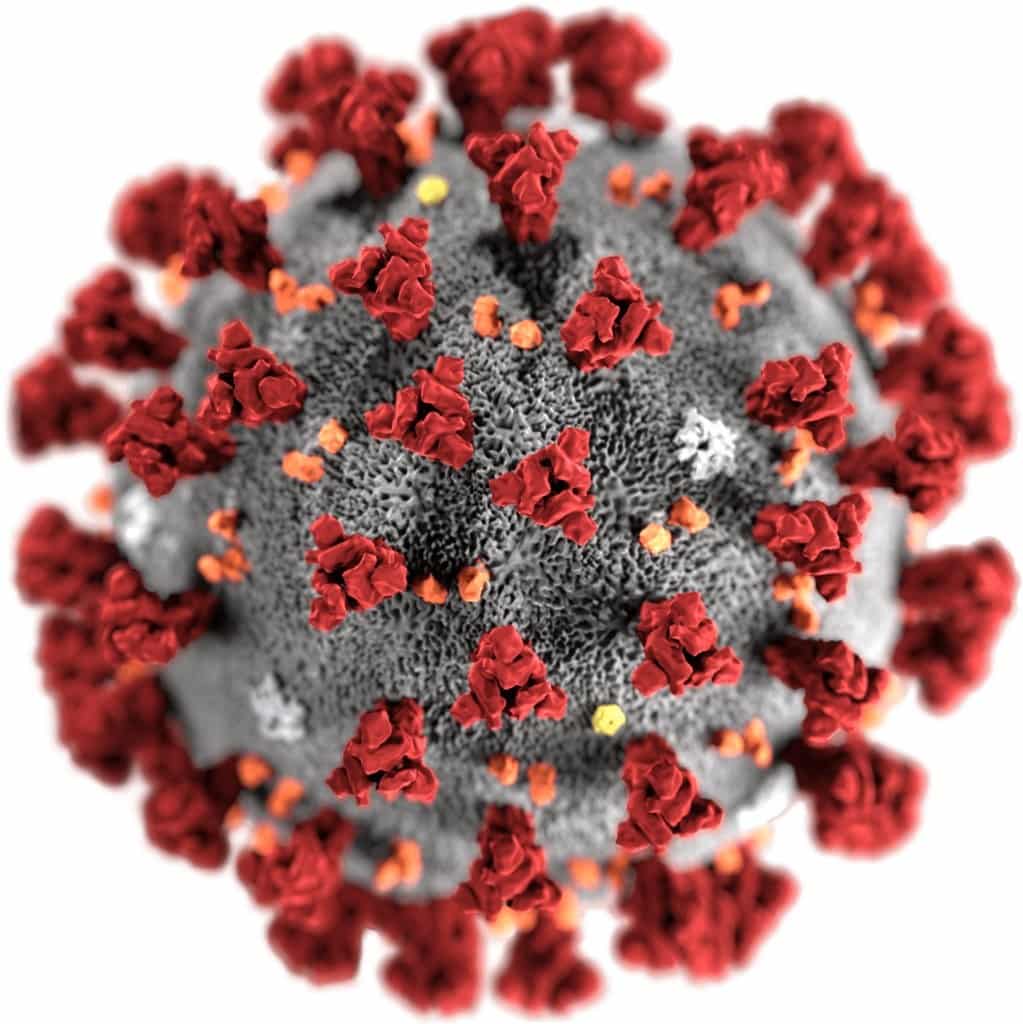
An illustration of the new coronavirus COVID-19. Image courtesy of the Centers for Disease Control.
A model created by the Massachusetts Institute of Technology and Hartford HealthCare suggests Connecticut has reached the peak of the COVID-19 pandemic in the state.
Dr. Ajay Kumar, Hartford HealthCare’s chief clinical officer, said Tuesday he believes the state is in the plateau period of that peak, with the number of hospitalizations holding steady.
“Going forward, we’re going to see a trending down, at least for hospitalization,” he said.
The number of people reported to be infected with the new coronavirus will continue to rise in Connecticut because testing is being ramped up, Kumar said.
Because of the early limits in testing, there could be as many as five to 10 people infected for every positive test reported, he said. The model predicts that as many as 6,000 people could eventually die in Connecticut from coronavirus-related causes, though Kumar said he believes the death toll will be lower.
Meanwhile, officials from Connecticut’s Department of Public Health unveiled Tuesday details of a new voluntary initiative to trace contacts of residents diagnosed with COVID-19, an undertaking planned to begin statewide in May that will involve local health departments, hundreds of volunteers and Microsoft.
Kristen Soto, an epidemiologist at the state agency, said the effort is similar to past efforts to track and stop the spread of small clusters of measles cases from turning into larger outbreaks, but contact tracers will be using a new technology called “contaCT.” People who’ve tested positive in Connecticut will be contacted by a public health professional or trained volunteer by text message, email or over the phone and asked about their illness and potential exposure to other people — information that will be examined using the new software. They’ll then be urged to self-isolate in hopes of interrupting the chain of transmission.
Soto said the initiative is expected to be operational statewide by mid-May. Officials have said both testing and contact tracing will be key to deciding when to lift various restrictions.
“Without contact tracing, people might spread COVID-19 unknowingly,” Soto said during Lamont’s daily briefing.
As of Tuesday, there have been 26,312 positive cases of COVID-19 in Connecticut, an increase of 315 since Monday, which Lamont said is the lowest number of new cases in weeks. Meanwhile, there have been 2,089 deaths associated with COVID-19.
State Epidemiologist Matthew Cartter said he expects testing in Connecticut will “dramatically” increase from the roughly 2,000 tests per day to 50,000 per week by the end of May.
For most people, the virus causes mild or moderate symptoms, such as fever and cough, that clear up in two to three weeks. For some, especially older adults and people with existing health problems, it can cause more severe illness.

