




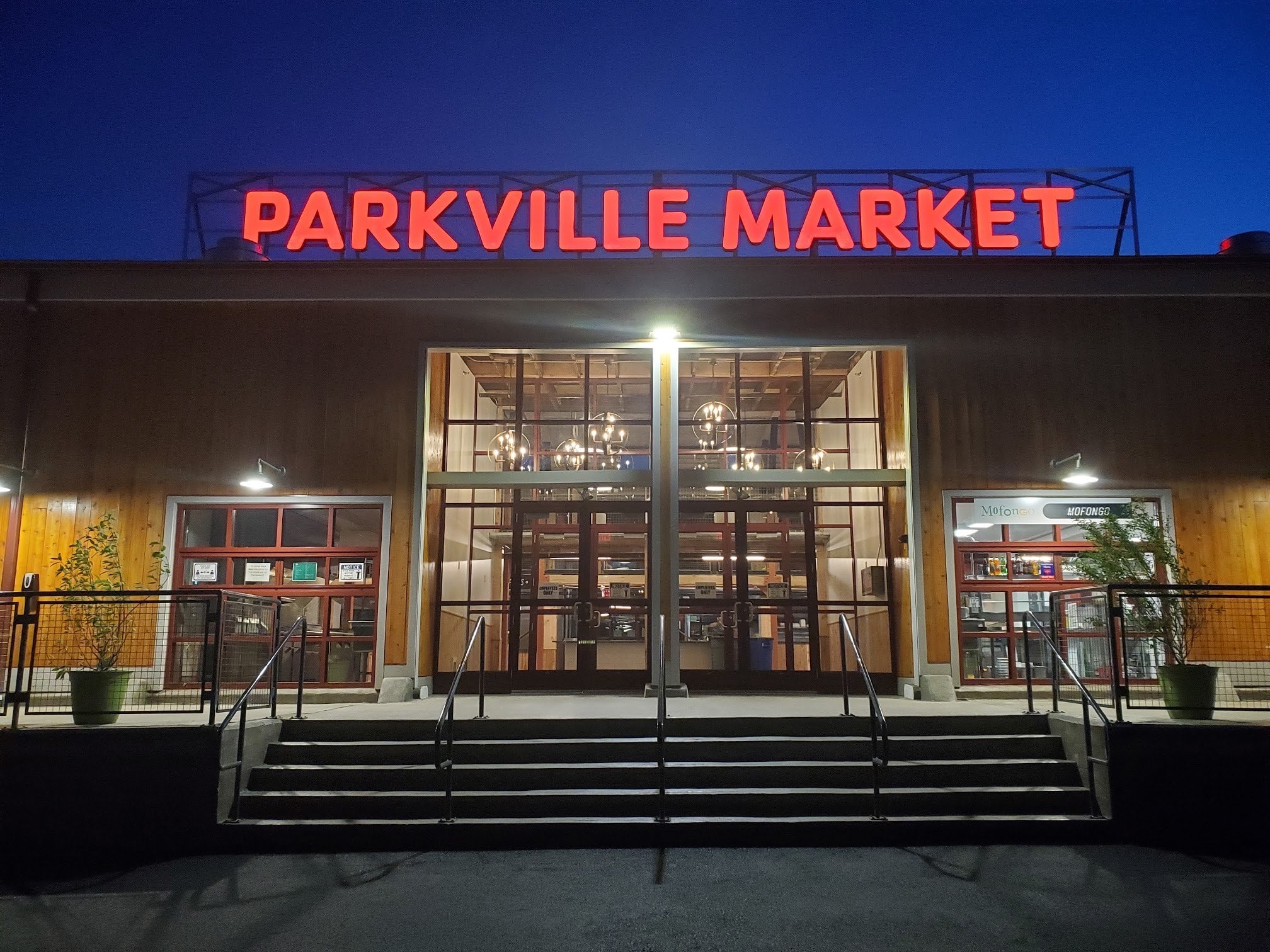
Connecticut’s first food hall had to shift on the fly as the Parkville Market’s completion coincided with the COVID-19 pandemic. Fifteen vendors now are operating in the converted warehouse in Hartford. Photo courtesy of Carlos Mouta
The timing could hardly have been worse to be wrapping up construction of Connecticut’s first food hall in March, as the COVID-19 pandemic triggered bans on large gatherings.
Carlos Mouta, developer of Hartford’s Parkville Market food hall, regrouped and reopened the venue in May for takeout and has since expanded to outdoor dining. And he reconfigured some of the space in the 2-story, 20,000-square-foot industrial building at 1400 Park St., dedicating second-floor space that had been envisioned as retail shops into private dining rooms to achieve distancing.
“We deal with these things as they come,” said Mouta, who has converted a series of industrial buildings in Parkville into housing. “We can’t control everything, so we have to adapt and move on and that’s it. So far I’m very happy with what we’ve done.”
Mouta estimated the complex has attracted up to 4,000 visitors on weekends during the summer.
A native of Mozambique who grew up in the Parkville neighborhood, Mouta worked as a circulation supervisor for The Hartford Courant before embarking on his real estate development career. He has focused on industrial conversions, but began considering a food hall after visiting others including the Time Out Market in Lisbon, Portugal that’s now expanding in the U.S.
The Parkville Market project transforms a former Bishop Ladder Co. property, which Mouta bought in 1999. Over the past two years, he’s spent an estimated $6 million on site work and building improvements.
Fifteen vendors are currently operating, and Mouta is evaluating proposals for tenants to occupy the five remaining stalls on a rotating basis. Vendors pay $1,500 in base rent for a single stall and 15 percent of their sales in percentage rent. Local operators ranging from food trucks to restaurant chefs looking for their own spaces signed on, said Mouta, who leased the property without a broker and received many inquiries from prospective tenants who had seen local news coverage about the project. Each stall contains a different ethnic cuisine, Mouta said, to maximize the diversity of offerings.
A Flexible Financial and Physical Model
The notion that food halls – with their bench-style seating shared by diners and dozens of vendors – would be positioned to survive and even thrive during a pandemic might sound far-fetched. But research by a global real estate brokerage suggests that the food hall model could throw a lifeline to the reeling restaurant industry.
“Food halls are not the answer to every issue and not every piece of real estate should turn itself into a food hall, but they can be very useful and have halo effects,” said Phil Colicchio, executive managing director for Cushman & Wakefield’s specialty food and beverage consulting practice.
A May report assessing COVID-19’s effects on the restaurant industry said food halls could offer a path back into the industry for restaurateurs whose ventures have failed.
Whereas a traditional restaurant has startup costs ranging from $250,000 to $2 million, including real estate buildout, landlords typically foot the bill upfront to equip food halls with fixtures and equipment. Most food halls operate on a percentage rate basis, without base rents or leases. The structure enables restaurants to limit real estate costs, in an industry where operators typically need to keep rents to below 10 percent of gross revenues to be profitable, Colicchio said.
“It’s a good-faith gamble by each party,” he said. “The owner doesn’t get a guarantee and the vendor doesn’t get a guarantee, so they’re both highly motivated to deliver.”
While vendors have minimal startup costs, landlords get flexibility to change the mix of tenants more frequently. Food hall license agreements typically run for one to two years, and landlords usually have centralized point-of-sale systems that enable them to monitor sales in real time and identify poor performers.
Even before COVID-19, the traditional restaurant business model was severely challenged, Cushman & Wakefield reported, with non-fast food operators ranging from neighborhood pizza parlors to chef-driven bistros struggling to attain profit margins above 10 percent. And the industry has notoriously high failure rates.
“If 20 percent of restaurants fail during arguably the best economic times we’ve ever seen, that’s not a good model,” Colicchio said.
Approximately 165 food halls are in development in the U.S., and of the 35 projects that Cushman & Wakefield is advising, only one has dropped its plans, he said.

