




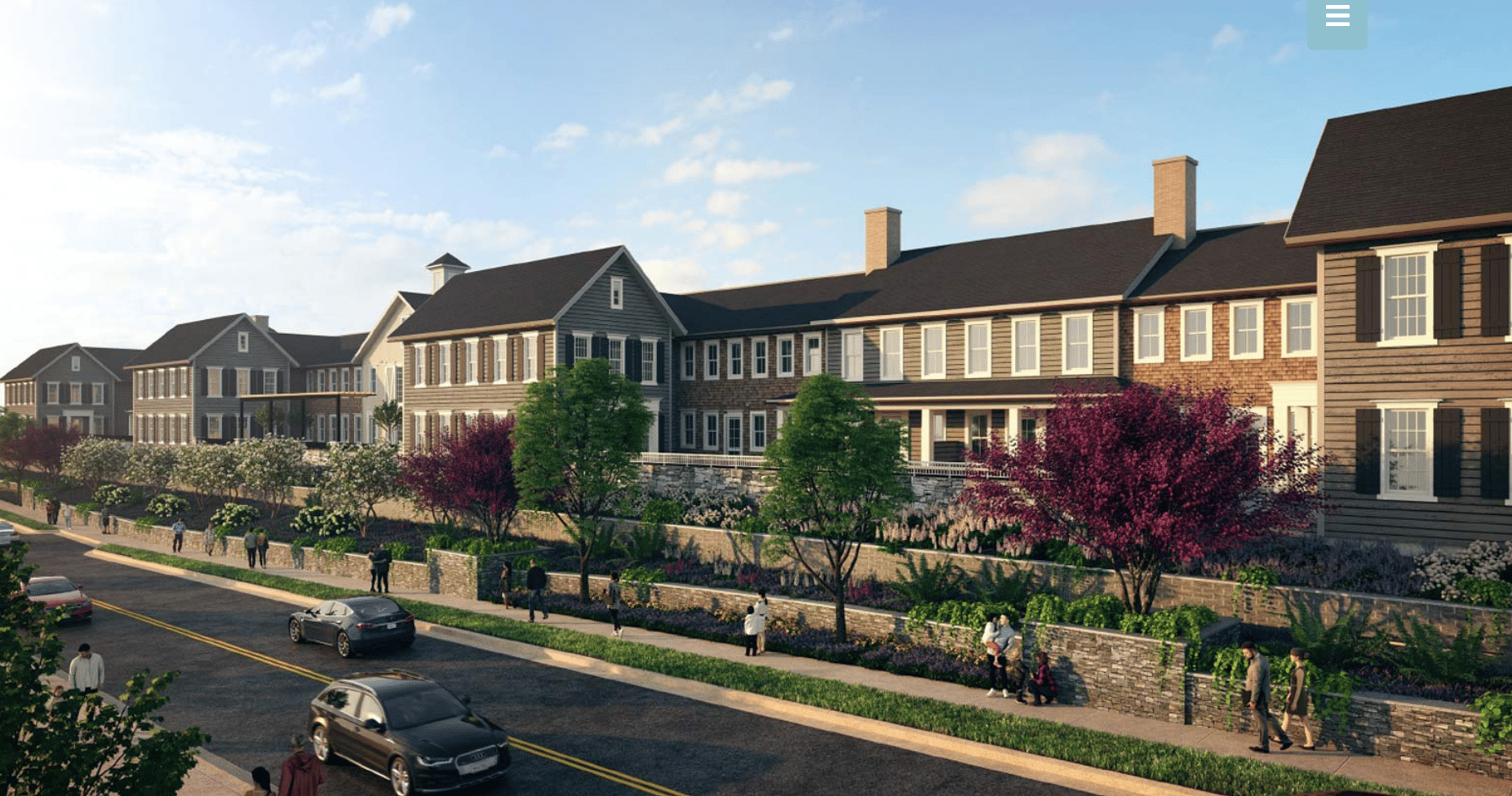
Construction of 122 townhouse-style apartments is under way at The Commons at Darien, where owner Federal Realty Investment Corp. is redeveloping a section of the shopping center previously occupied by Stop & Shop Supermarket and Walgreens. Image courtesy Federal Realty Investment Trust
A glut of retail space and steady demand for housing make a compelling argument for shopping center owners to maximize the value of their real estate by adding multifamily development.
The trend is gaining a foothold in Connecticut, as Federal Realty Investment Trust develops 122 apartments at The Commons at Darien, a grocery-anchored shopping center that it acquired in 2013 with expansion potential in mind. And Dallas-based Centennial Real Estate is seeking local approval for 300 apartments at its Connecticut Post Mall, the state’s largest retail property.
“Brick-and-mortar retail is facing tremendous headwinds and the amount of available space is obviously outpacing demand, so the opportunity to reinvest and reinvent the asset is enhanced by mixing up the uses,” said Jon Meshel, senior vice president of development for Centennial Real Estate.
The strategy has prompted a series of redevelopment projects nationwide, particularly in urban and inner suburban areas where vacant land is scarce. The International Council of Shopping Centers said it does not keep tabs on the amount of housing being added to retail centers. But in Greater Boston, developers are proposing or have gained approval for more than 2,200 apartments and condos at shopping centers anchored by Stop & Shop and Whole Foods Markets since 2019.
Darien Development
Federal Realty, a Maryland-based retail REIT, has been diversifying its asset mix for two decades by adding uses such as office space, apartments and condos at its shopping centers in inner suburbs, Senior Vice President Patrick McMahon said. The company acquired the Darien property near the Noroton Heights station on the MetroNorth Railroad for $47.3 million in 2013.
Stop & Shop’s decision to consolidate its two Darien stores, and close The Commons at Darien location, created additional development capacity.
The redevelopment, designed by Norwalk-based Beinfield Architecture, began six months ago with demolition of the Stop & Shop space and a Walgreens drug store, which will occupy a new 12,000-square-foot pharmacy scheduled to open next spring.
The residential portion will comprise 122 units in a pair of three-story buildings with ground-floor retail space, with average apartments spanning approximately 1,000 square feet, McMahon said. While rents will be announced closer to the planned completion date in early 2022, he estimated prices starting in the low $2,000 per month range.
Anchors Depart from Largest Mall
The 1.3 million-square-foot Connecticut Post Mall’s owners had been considering adding housing to a portion of the 75-acre property for several years, Meshel said, and pressures on the property’s financial performance have been intensified by the departure of anchor tenants Sears and J.C. Penney. Pennsylvania department store chain Boscov’s replaced J.C. Penney, but mall ownership is still weighing its options for the Sears space, Meshel said.
“We look at it as a big opportunity to enhance the property with either additional retail, food or mixed-uses,” he said.
The mall’s current vacancy rate was not available from Centennial, but executives estimate visitor traffic has declined 20 percent in the past five years. Over the past decade, the property’s assessed value has declined from $176 million to $149 million, according to community presentation materials by the developer.
The residential development would increase annual real and property taxes by 28 percent to $1.2 million, the company estimates. The housing component would be built on a portion of the 75-acre property’s parking lot.
Local Opposition
The proposal attracted recent blowback from Milford Mayor Ben Blake, who called it a “terrible idea” according to an Aug. 11 report in the New Haven Register, and asked Centennial to consider building office space for tech and life science companies instead. Blake could not be reached for comment, but Centennial’s Meshel said the company is “definitely willing to consider that based upon market demand.”
Centennial has submitted a zoning amendment proposal to the Milford planning and zoning board, which would vote both whether to approve it and any subsequent development, Milford City Planner David Sulkis said. The rezoning requires a minimum seven “yes” votes from the 10-member board.
While the strategy of replacing retail with housing seems like a can’t-miss bet, such redevelopments have their complexities and need to be considered on a case-by-case basis, Federal Realty’s McMahon said.
“To most folks, it’s pretty obvious,” he said. “Why wouldn’t you? One of the primary complicating factors is existing shopping centers have existing tenants who have term [remaining on leases]. Convincing tenants to live through a 24- or 36-month redevelopment is hard to do. Some are doing great, and don’t want you to touch the center.”

