




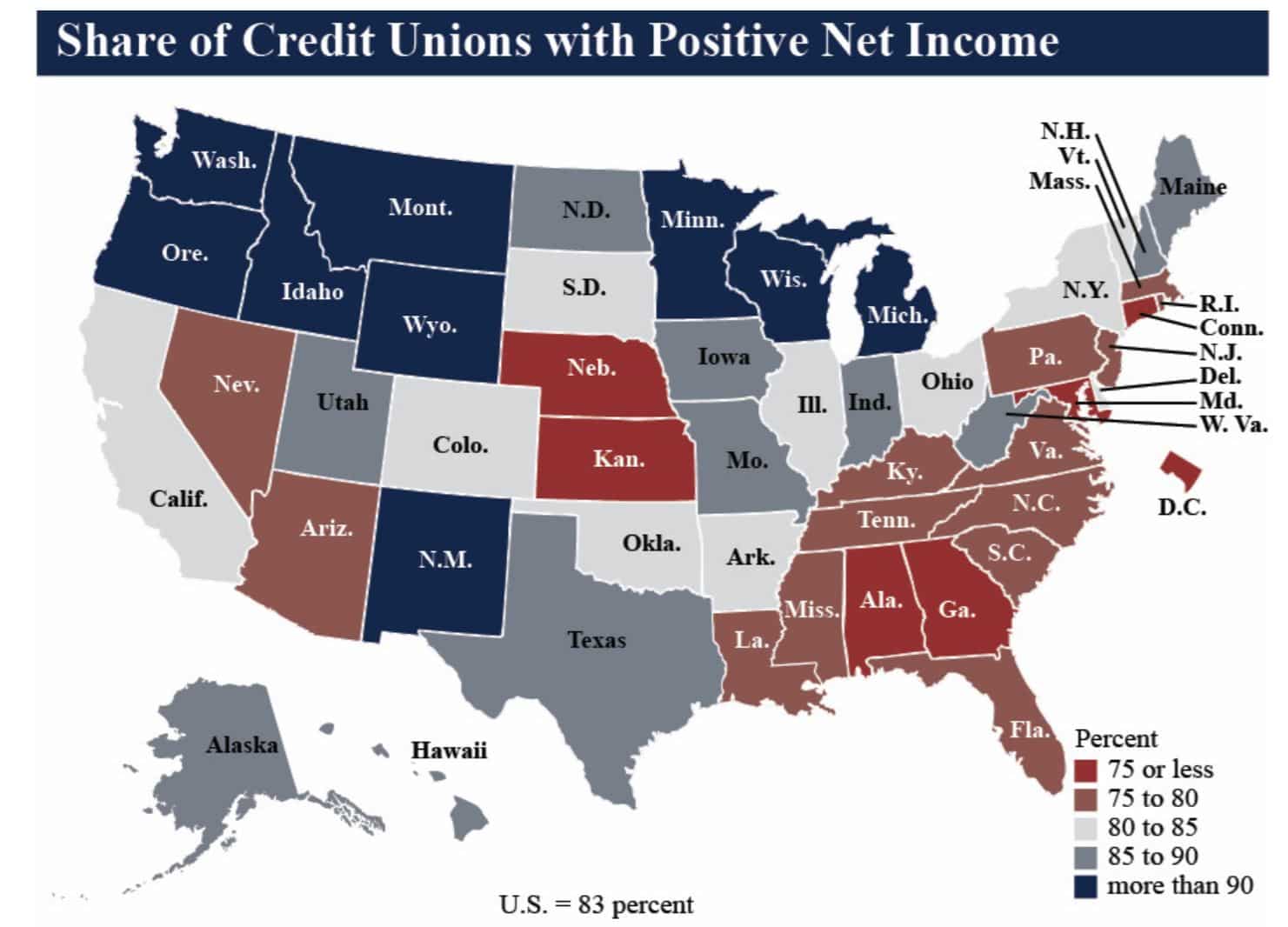
Share of U.S. credit unions with positive net income in 2020. Image courtesy of NCUA Quarterly U.S. Map Review.
Connecticut’s share of credit unions with positive net income was among the lowest in the U.S. in 2020, although a majority of the state’s institutions did see positive income, according to data released last week by the National Credit Union Administration.
The NCUA Quarterly Map Review showed that 70 percent of Connecticut credit unions had positive net income in 2020, below the U.S. average of 83 percent. In 2019, 78 percent of the state’s credit unions had positive net income compared to 89 percent nationwide.
As in 2019, Connecticut’s share of credit unions with positive net income was among the lowest in the U.S. Only Kansas ranked lower with 69 percent. New Mexico and Washington had the highest share of credit unions with positive net income in 2020 with 98 percent.
Membership declined at a majority of Connecticut credit unions in 2020 compared to 2019. The state’s median membership growth rate was -1.3 percent, meaning that half of the state’s approximately 90 credit unions saw membership decline by 1.3 percent or more. Only New Jersey and Massachusetts, with median growth rates of -2.4 percent and -1.4 percent, respectively, saw a greater membership decline.
The NCUA said 56 percent of U.S. federally insured credit unions had fewer members at the end of 2020 compared to 2019. The U.S. credit unions with falling membership tended to be small, the NCUA said, with 65 percent having less than $50 million in assets. The national median growth rate was -0.5 percent. Credit unions headquartered in Alaska and Idaho had the highest median membership growth rates of 3.7 percent and 2.3 percent, respectively.
Connecticut credit unions had a median year-over-year asset growth of 14.4 percent compared to 1.9 percent at the end of 2019. The national median in 2020 was 14.2 percent compared to 2.8 percent at the end of 2019.
The state trailed the U.S. median for annualized year-to-date return on average assets in 2020. Connecticut was among the bottom three states with a median of 19 basis points compared to the U.S. median of 40 basis points. The state had ranked at the bottom in 2019, with a median annualized ROAA of 36 basis points compared to the U.S median of 60 basis points.
Like banks, credit unions have seen deposits surge during the pandemic. The median year-over-year deposit growth was 16.3 percent in Connecticut, meaning half the credit unions saw growth at that rate or higher. The U.S. median deposit growth was 15.9 percent. Connecticut in 2019 saw year-over-year deposit growth of 1.8 percent, while the U.S. median that year was 2.6 percent.
Loans declined at most of the state’s credit unions in 2020, with Connecticut’s median year-over-year loan growth rate at -4 percent. The U.S. median in 2020 was -0.9 percent. The state’s median delinquency rate was 58 basis points compared to the U.S. median in 2020 of 51 basis points.

