




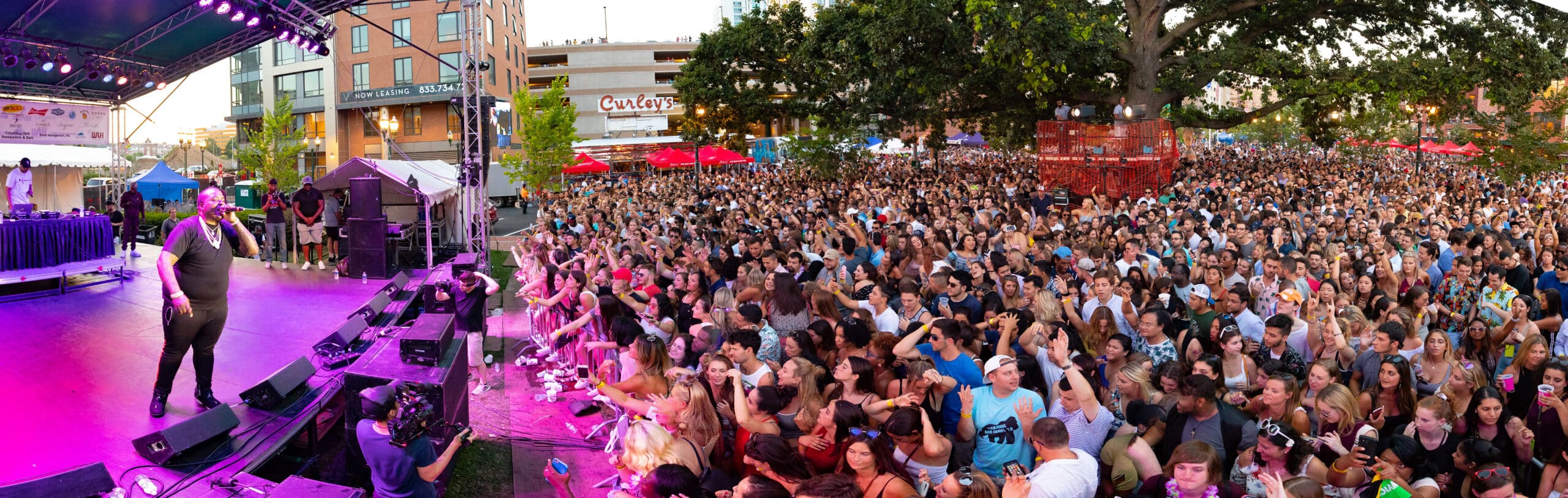
The Stamford Downtown Special Services District sponsors events designed to enhance the vibrancy of the city’s commercial core, such as the “Alive@Five” concert series. Photo courtesy of happyhaha.com
As office tenants ponder their return-to-work strategies, southwestern Connecticut has yet to capture a hoped-for migration of companies that mirrors the gains in its residential real estate market.
Fairfield County has been the recent epicenter of the Connecticut housing market’s resurgence during the COVID-19 pandemic, and economic development officials are hoping that migration spills over into increased demand for workspaces close to home. They’re redoubling their pre-pandemic strategies in an effort to attract the tech-savvy workforces that have gravitated to coastal metros in the past decade, and the related companies that cluster there.
“We need a lot more talent in that area in this region to be more competitive in the long term,” said Jon Winkel, CEO of the Stamford Partnership, a public-private economic development group. “We hear it both from the companies and the commercial real estate industry all the time. Basically, the conversation begins and ends with computer and data science talent.”
Newly-released brokerage research shows that the Fairfield County office market has failed to reap many benefits from changing workplace patterns during the pandemic. The countywide vacancy rate hit an all-time high of 30.9 percent, according to Cushman & Wakefield’s first quarter MarketBeat report. Average asking rents now sit at $0.53 below the five-year quarterly average of $33.16 per square foot.
Most office tenants have held off on real estate decisions during the pandemic amid widespread uncertainty about post-COVID workplace models.
In Fairfield County, the primary beneficiary has been the downtown Greenwich submarket, which accounted for 32 percent of all county leasing activity in the first quarter, according to CBRE’s first-quarter MarketView report. Some 54 percent of new leases and expansions in the Greenwich central business district have come from New York City tenants since the beginning of the pandemic.
“As an established destination for financial service firms, this submarket has attracted several tenants from New York City for interim space solutions as they sort out future re-occupancy plans,” the report states.
Across the 41 million-square-foot countywide office market, the largest new lease signed during the first quarter was 45,800 square feet by New York-based Digital Currency Group at 290 Harbor Drive in Stamford. Another Manhattan-based financial company, Elliott Capital Management, signed a 40,000-square-foot sublease at 600 Steamboat Road in Greenwich.
The 10.4 million-square-foot downtown Stamford north submarket has the county’s highest availability rate at 30.7 percent and its highest vacancy rate at 29.3 percent, according to CBRE.
Suburban Atmosphere, Downtown Amenities
During a webinar sponsored by the Building Owners and Managers Association (BOMA) Southern Connecticut last week, Fairfield County economic development officials said the region needs to create an organic business growth system rather than seeking to lure out-of-state companies. Partnerships between higher education and industry fueled the explosive growth of tech clusters in cities such as Boston and San Francisco, noted Nick Simmons, a former economic development adviser to Gov. Ned Lamont.
“The ecosystem in Fairfield County needs so badly to bring together these disparate pieces that can be in silos and are not operating together,” said Simmons, who was chosen by President Biden in April as a senior adviser to the Secretary of Education.
Stamford Downtown President David Kooris said the region benefits from the proximity to New York City’s economic engine while offering a lower-key lifestyle. Occupancy rates are near 100 percent at downtown Stamford apartment buildings, a reflection of the city’s current desirability. And all 95 restaurants in the downtown district have survived the pandemic so far.
“We have access to the urban core in Manhattan, but also that suburban sensibility that blends together light and open space and quality of life with all the positives that combine for a vibrant and growing downtown,” Kooris said.
The organization is a business improvement district established in 1992 to enhance streetlife and events – ranging from concerts to farmers’ markets – to enhance the value of downtown commercial properties. In the post-pandemic era, that mission will become more critical than ever in convincing companies and their employees to spend more time in the downtown area.
“Our job in the downtown is enhancing and activating those spaces between building facades to such a degree that the experience downtown becomes so much value-added relative to the experience of working remotely,” Kooris said.

