




Photo by Joe Ravi | CC BY-SA 3.0
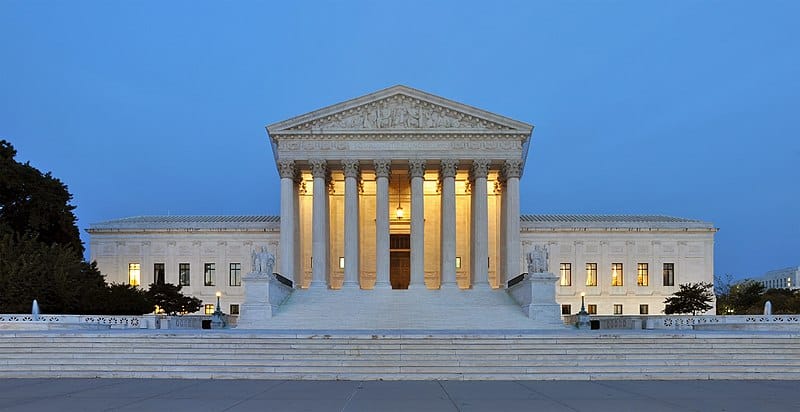
The Supreme Court’s conservative majority is allowing evictions to resume across the United States, blocking the Biden administration from enforcing a temporary ban that was put in place because of the coronavirus pandemic.
The court’s action ends protections for roughly 3.5 million people in the United States who said they faced eviction in the next two months, according to Census Bureau data from early August.
The court said late Thursday in an unsigned opinion that the Centers for Disease Control and Prevention, which reimposed the moratorium Aug. 3, lacked the authority to do so under federal law without explicit congressional authorization. The justices rejected the administration’s arguments in support of the CDC’s authority.
“If a federally imposed eviction moratorium is to continue, Congress must specifically authorize it,” the court wrote.
The three liberal justices dissented. Justice Stephen Breyer, writing for the three, pointed to the increase in COVID-19 caused by the delta variant as one of the reasons the court should have left the moratorium in place. “The public interest strongly favors respecting the CDC’s judgment at this moment, when over 90% of counties are experiencing high transmission rates,” Breyer wrote.
White House press secretary Jen Psaki said the administration was “disappointed” by the decision and said President Joe Biden “is once again calling on all entities that can prevent evictions — from cities and states to local courts, landlords, cabinet agencies — to urgently act to prevent evictions.”
The Treasury Department said Wednesday that the pace of distribution has increased and nearly a million households have been helped. But only about 11 percent of the money, just over $5 billion, has been distributed by state and local governments, the department said.
The administration has called on state and local officials to “move more aggressively” in distributing rental assistance funds and urged state and local courts to issue their own moratoriums to “discourage eviction filings” until landlords and tenants have sought the funds.
In Connecticut, about $45.5 million of the $235.9 million in federal rental aid money has been distributed to 5,798 households as of July 31. The state told The Associated Press earlier this month that 2,604 landlords had also received relief money. Additionally, more than $2.2 million has been disbursed for unpaid utility bills.
Connecticut was one of several states that enacted its own eviction moratorium in 2020. The state’s rule, which prevented landlords from filing most new eviction cases, with certain exceptions, expired on June 30.
Gov. Ned Lamont, however, signed an executive order on the same day that requires landlords to apply to the state’s UniteCT rental assistance program prior to issuing an eviction notice to tenants for nonpayment of rent.
The high court hinted strongly in late June that it would take this path if asked again to intervene. At that time, the court allowed an earlier pause on evictions to continue through the end of July.
But four conservative justices would have set the moratorium aside then and a fifth, Justice Brett Kavanaugh, said Congress would have to expressly authorize a new pause on evictions. Neither house of Congress has passed a new evictions moratorium.
The administration at first allowed the earlier moratorium to lapse July 31, saying it had no legal authority to allow it to continue. But the CDC issued a new moratorium days later as pressure mounted from lawmakers and others to help vulnerable renters stay in their homes as the coronavirus’ delta variant surged. The moratorium had been scheduled to expire Oct. 3.
The new moratorium temporarily halted evictions in counties with “substantial and high levels” of virus transmissions and would cover areas where 90 percent of the U.S. population lives.
The Biden administration argued that the rise in the delta variant underscored the dangers of resuming evictions in areas of high transmission of COVID-19. But that argument did not win broad support at the high court.

