




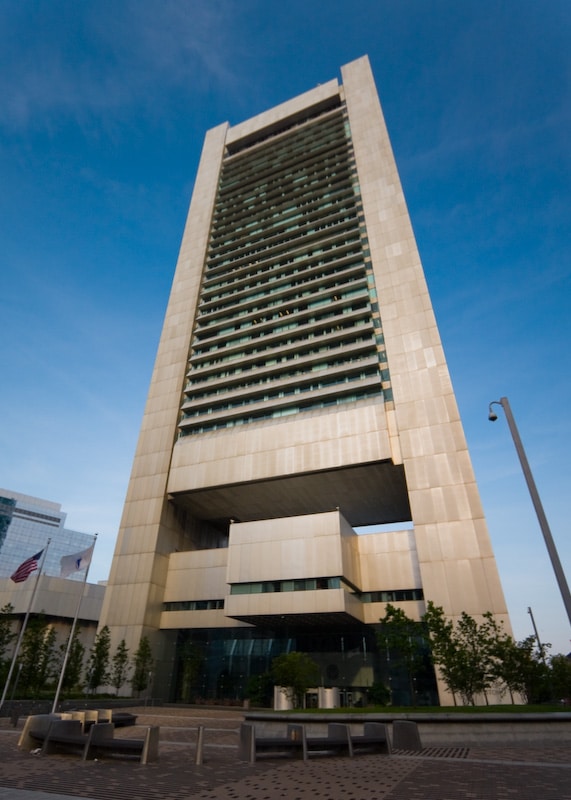
The headquarters of the Federal Reserve Bank of Boston. Image Courtesy of Fox-orian / CC BY-SA 3.0
Connecticut will continue to participate in the Federal Reserve Bank of Boston’s community development initiative that tackles issues ranging from inadequate child care to unemployment.
The state has committed $2 million over the next two years to continue participating in the Working Cities Challenge, the Boston Fed recently announced. The state’s allocation of $1 million per year for the next two years will support local organizations in five cities through 2023.
The challenge is a grant initiative to promote economic development in smaller, post-industrial cities. The Boston Fed had awarded Hartford, East Hartford, Danbury, Middletown and Waterbury $450,000 each in 2018 “to form organizations to take on chronic local issues, including high unemployment and underemployment, lack of access to educational resources, and economic inequality,” the Boston Fed said on its website.
The initial funding covered three years, expiring this year. Prabal Chakrabarti, executive vice president and community affairs officer for the Boston Fed, said the commitment represents “a big step forward.”
The Boston Fed’s Working Cities program includes 15 cities in Connecticut, Massachusetts and Rhode Island. Another program for northern New England’s rural areas operates as the Working Communities Challenge in Vermont and Maine.
Cities in Connecticut eligible for grants had to have a population greater than 25,000, median income below the state’s median, and a poverty rate above the state poverty rate. Grants are privately and publicly funded, the Boston Fed said.
Initiatives resulting from the grant include:
- Professional Skills Academy in East Hartford where local employers and career navigators help support residents seeking jobs.
- Middletown Works, a $500 mini-grant initiative for residents with ideas on expanding educational opportunities for students.
- In Hartford, youth leadership programs and partnerships with companies in the manufacturing and healthcare sectors that connect young adults with employment opportunities.
- A program in Danbury to reduce the poverty rate among the immigrant community and people of color by 5 percent.
- The RIBA ASPIRA initiative in Waterbury to reducing unemployment in the River Baldwin area and ensure more residents earn a living wage.

