




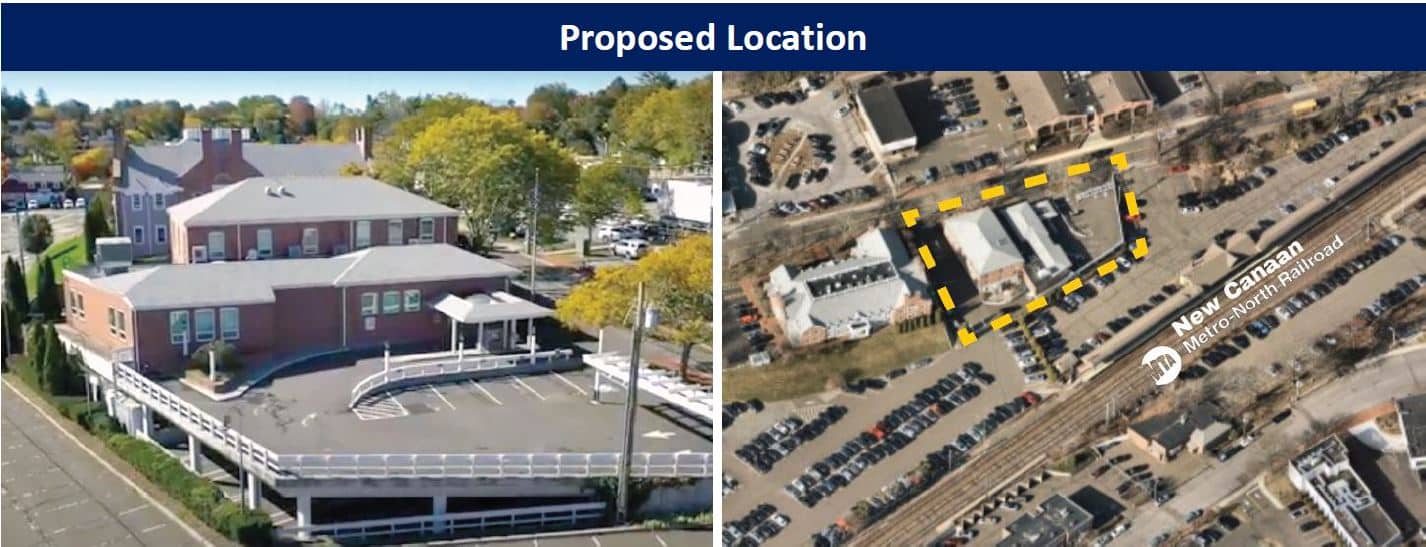
The proposed New Canaan Bank plans to open in Bankwell’s former Elm Street location. Image courtesy of New Canaan Bank
As the banking landscape continues to change amid factors ranging from mergers and branch closings to fintech competition and consumer behaviors, a group in Fairfield County sees an opportunity to open a new traditional brick-and-mortar community bank.
The group, which includes long-time banking executives, has applied to state and federal regulators to organize The New Canaan Bank, Connecticut’s first state-chartered traditional bank in more than a decade.
New banks, known as de novos, have become rare in the United States since the Great Recession as the process to form and then operate de novos presents challenges, including regulatory and financial.
But for the team behind The New Canaan Bank, the current banking landscape has created a need for more community institutions.
“The Organizers have identified an unfilled niche in the Fairfield County banking market,” the group said in its application submitted to the Connecticut Department of Banks. “As large banks acquired smaller ones and personal service was subjected to consolidation strategies, the opportunity has increased for locally-owned, operated and highly personal service-oriented banks.”
Organizers for The New Canaan Bank applied to form a state-chartered commercial bank with the Connecticut Department of Banks and the Federal Deposit Insurance Corp. in late December. If approved, the proposed bank would operate out of the former offices of another New Canaan community bank, Bankwell, which relocated its headquarters and consolidated branches last year.
Experienced Hands Team Up
The New Canaan Bank’s organizers include Fred Afragola, the founding chairman, president and CEO of Bankwell’s predecessor, the Bank of New Canaan. Afragola, who remained on Bankwell’s board of directors until 2017, was previously president and CEO of the former New Canaan Bank and Trust Co., joining that bank in 1994 after a career in manufacturing.
Afragola is the proposed executive chairman of the bank, and the proposed president and CEO is Lou Garcia, who spent four years as a managing director with New York-based CBAM Partners and 16 years at Addison Clark Management in Westport, where he was co-founder, partner and chief operating officer for the registered investment adviser, according to his resume.
Garcia said in an email that the organizers are working with the Connecticut DOB and the FDIC on getting a temporary certificate of authority. The group’s goal is to receive the temporary certificate in the spring and then open the bank in June, Garcia said.
The proposed bank plans to offer traditional products focused on consumers, small businesses and non-profits, Garcia said, including residential lending, deposit accounts, commercial real estate lending and business banking.
The city of New Canaan offered an opportunity for a new bank because of recent market disruptions that have resulted in fewer banking opportunities for customers, the group said in its business plan submitted as part of the application to regulators. The disruptions cited included the closing of a TD Bank branch in New Canaan, Bankwell’s branch consolidation and the expected acquisition of Bridgeport-based People’s United Bank by Buffalo-based M&T Bank.
“With the historical decrease in the number of locally-owned and operated community banks, the organizers, based on our relationships with the community, have determined that existing banks are not providing the level of service and credit desired by consumers and the small to medium-sized business owners in New Canaan and surrounding marketplace,” the application said.
Barriers for De Novos
In recent years, Connecticut has seen a new trust bank, Voya Institutional Trust Co., while a couple of uninsured challenger banks have received temporary certificates of authority to form, according to the Connecticut DOB’s website. The New Canaan Bank would be the first brick-and-mortar bank to form since the 2010 opening of Start Community Bank, now known as New Haven Bank.
De novos at one time had a significant presence in banking. Between 1984 and 1992, the U.S. averaged 196 de novo banks per year, according to the Independent Community Bankers of America. Last year, the U.S. saw about 10 new banks, and just five in 2020.
New England had a couple of de novos open in 2019: New Valley Bank & Trust in Springfield, Massachusetts, and Milyard Bank in Nashua, New Hampshire.
While another de novo in New Hampshire is looking to become a mutual bank, most new banks form with capital raised from investors. The capital raise creates a barrier for anyone looking to start a bank, said Jeff Marsico, president of Pennsylvania-based consulting firm The Kafafian Group.
Bank regulators typically look for a new bank to raise between $20 million and $30 million, Marsico said, and investors could end up waiting five to 10 years before accessing the investment, which remains illiquid for several years.
Even if investors eventually do sell their stock, positive returns are not guaranteed, Marsico said. Regulators expect de novos to maintain a certain leverage ratio, limiting how much the bank can grow. So, a 10 percent leverage ratio on a bank that started with $20 million means the bank could only grow to $200 million in assets – or less, since the startup process would have already used up some of the bank’s capital, Marsico said.
“It’s difficult to achieve peak profitability at that size bank, so the bank has to be bigger,” he said.
To grow bigger, de novos can try to raise more capital, or they can retain earnings and accept that growth will be slow since the bank’s size can only increase as fast as its capital, Marsico said.
Today’s de novo banks do have an advantage over some existing institutions, Marsico said, because they are not saddled with legacy technology systems, starting instead with options for choosing the latest digital offerings. He added that community banks that maintain close relationships with customers still have an important role in the U.S. economy.
“In a capitalist economy, you continuously regenerate businesses,” Marsico said. “That bank that takes capital from the people that have it and lends it to people that need it – the community bank does that in really tight concentric circles, and I think that depositors are starting to understand that.”
Longtime Banking Experience
The New Canaan Bank plans to start with between $30 million and $40 million, raising common equity from investors in the Fairfield County area, Garcia said.
In addition to Garcia and Afragola, other investors include Paul Kuehner, president of the commercial real estate firm Building and Land Technology and The New Canaan Bank’s proposed board chairman. Heidi DeWyngaert, who spent 15 years at Bankwell and the Bank of New Canaan before retiring in 2019, has also made a capital commitment and is a proposed board member of the bank.
John Lund, a former FDIC examiner and chief financial officer for several community banks and credit unions, is slated to be the de novos’ chief financial officer.
The group has no plans for additional branches in the “foreseeable future,” Garcia said, adding that the proposed bank would have a high-touch and relationship-based approach while providing customers with modern and efficient digital banking services.
“The proposed bank will provide community-oriented, personal and commercial banking services to customers not only in New Canaan but throughout Fairfield County,” Garcia said. “Collectively, the Organizers and proposed Directors have nearly 100 years of successful banking experience in New Canaan managing successful institutions and understanding the local need for personalized products and services.”

