




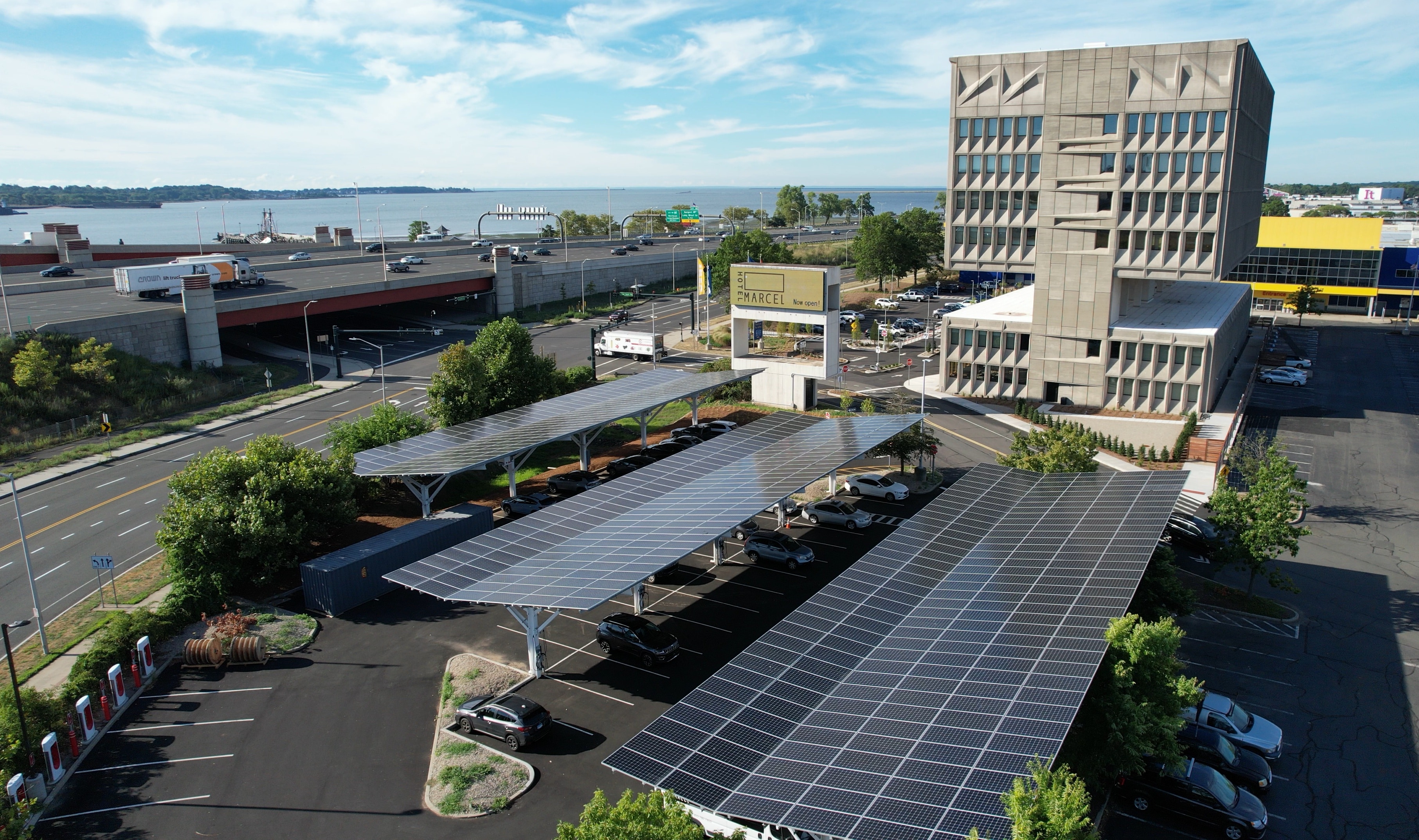
Becker + Becker’s Hotel Marcel in New Haven combined adaptive reuse of a long-vacant office building with sustainability upgrades that will deliver operating savings to ownership, including solar arrays and an on-site microgrid. Photo courtesy of Becker + Becker and Nuveen Green Capital
Connecticut’s hotel industry was enjoying small but steady growth before COVID-19 disrupted business and leisure travel, dampening development and prompted some hotel owners to begin conversions to other uses.
One project that moved forward with financing obtained before the pandemic is now reaping benefits with above-anticipated occupancy levels and room rates, in a sign of the New Haven hospitality market’s resilience.
“There are always barriers to entry in the New Haven market, and those will continue,” said Bruce Becker, a Westport developer and architect whose 165-room Hotel Marcel opened in May in New Haven’s Long Wharf District. “The new barrier is it’s so expensive to build anything now. But we were lucky to do our bidding before the pandemic and the supply chain disruptions.”
The adaptive reuse of a long-vacant office building received $25 million in construction financing from Liberty Bank just before the pandemic in early 2020, enabling it to break ground despite plummeting hotel occupancy rates.
The boutique hotel, part of the Tapestry Collection by Hilton brand, has exceeded Becker’s financial projections in its first five months of operation. Occupancy rates approached 70 percent in late October, Becker said, and revenues per available room (RevPAR), a key metric of a hotel’s performance, exceeded a peer group of New Haven-area hotels according to hospitality STR Inc. data. Occupancy routinely tops 90 percent on weekends, and is expected to rise further when business travel rebounds, following the recovery of the leisure market, Becker predicted.
Enhancing Profits Through Operating Savings
A series of energy sustainability upgrades to the 53-year-old modernist structure designed by Hungarian architect Marcel Breuer are expected to steeply reduce operating costs at the first net-zero hotel in the U.S.
In October, Becker + Becker received $7 million in low-cost financing through Darien-based Nuveen Green Capital from the Commercial Property Assessed Clean Energy (C-PACE) program to pay for the energy projects.
Designed to meet Passive House standards, the Hotel Marcel reduces estimated energy usage by approximately 80 percent through efficient building systems and a sealed building envelope including triple-glazed windows. Rooftop and parking lot solar arrays totaling 1,000 panels can produce approximately 550,000 kilowatt hours of energy annually, which will be stored in an on-site microgrid. Building systems run on electric heat pumps.
“We’re doing our part not to make the climate crisis any worse, but we’re also saving money,” Becker said. “Reducing your expenses by a dollar is better than increasing revenues by a dollar, because you keep all the difference rather than sharing [additional] revenues with the franchiser.”
Hotel Developers to Add 527 Rooms in 2022
Like most of the U.S. hospitality industry, Connecticut’s hotel industry was expanding prior to early 2020. The state trailed neighboring states such as Massachusetts and Rhode Island in new openings, but still had increased its lodging supply by 0.9 and 0.7 percent respectively in the two years leading up to the pandemic, according to Pinnacle Advisory Group, a Massachusetts hospitality industry research firm.
In 2022, Connecticut’s room supply has declined 2 percent, according to researchers STR Inc., because of hotel closures and conversions to multifamily housing.
Representatives from the New Haven-based Connecticut Lodging Association did not respond to inquiries about the state of the local industry.
According to Pinnacle research, the Hotel Marcel is one of three that have opened in the state this year, along with the 130-room Cambria in New Haven and 108-room Cambria in South Windsor. Two others are scheduled to open by year’s end: a 100-room Holiday Inn Express in Windsor and the 24-room Hotel Chelsea in Norwich. Openings scheduled for 2023 include the 90-room Home2Suites by Hilton in Bristol, 127-room Residence Inn by Marriott in Hamden and a 70-room Fairfield Inn by Marriott in East Hartford.
The long-term pipeline includes an additional nine hotels that would add more than 1,400 rooms, according to Sebastian Colella, vice president at Pinnacle Advisory Group.

