




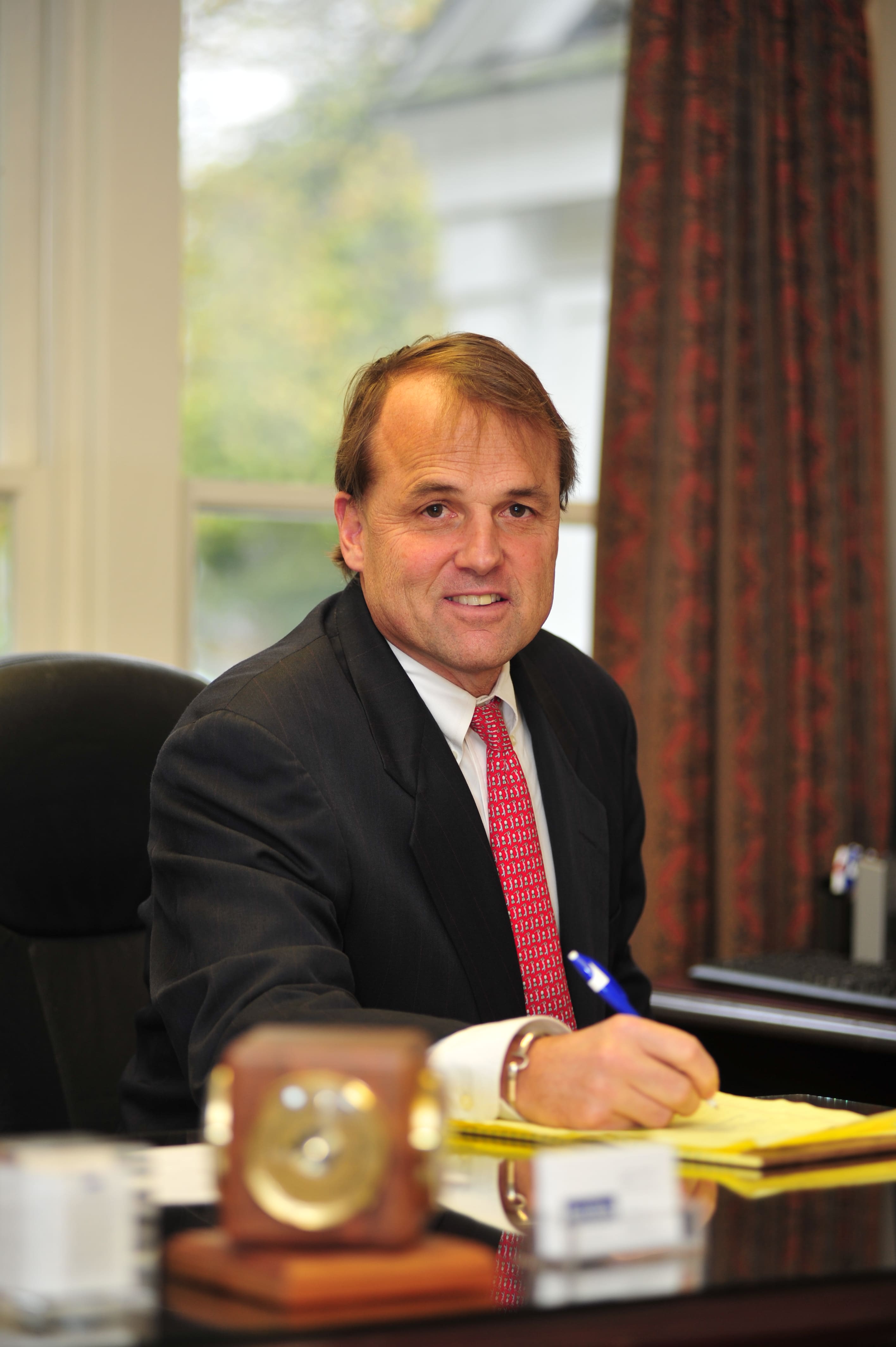
Steven Cornell
President and CEO, National Iron Bank
Age: 63
Industry experience: 35 years
The 18th and 19th centuries gave the northwest corner of Connecticut a booming iron industry, which included the making of cannonballs. But the region had no bank. Workers had to travel by horseback to the nearest bank in Litchfield. In August 1847, a group of businessmen launched the Iron Bank to provide banking services to the industry and its workers. It became a national bank in 1865, and this year celebrated its 175th anniversary.
While one of the oldest Connecticut banks, second only to Middletown-based Liberty Bank, National Iron Bank is also one of the state’s smallest banks with about $270 million in assets. For President and CEO Steven Cornell, the bank’s size is one of its strengths, and he expects National Iron Bank to continue to grow. After getting an MBA with a focus on computer science, Cornell started his banking career at Bank of Boston supporting its computer network. He joined National Iron Bank 30 years ago.
Q: What’s it like to be a leader of a bank that has such a long history?
A: It’s an honor. I just feel I’m a steward of a long, long-time business. My predecessor [Richard Wardell] still is chairman of the board at 89 years old. He ran the bank for a long time. He doesn’t come in every day anymore, but he still keeps his hand in the business. My objective is to keep it healthy and keep it running, hopefully to the 200th anniversary and more. There’s importance to community banks, and with technology, they can do a lot more. We’re very highly automated, especially because of my background in computer science, which has helped us. I feel I’m just a steward taking it and continuing to run it the way it has for 175 years – very conservatively
Q: What are some of your goals for the bank?
A: I want to continue to grow the bank. We’ve seen great growth, especially since COVID. I want to continue to service our communities because I think it’s really important. We’re in the northwest corner of Connecticut, and I think the bank is a very important part of the towns. We really support the nonprofits, and every dollar that we take we reinvest back in our communities. I think the community banks are very important, especially for the smaller towns in Connecticut and across the country.
Q: What has driven some of the growth over the last couple of years?
A: There’s been a lot of consolidation of banks. A lot of people like the idea of coming to a community bank where they can actually talk to somebody and not be put on hold or have to wait to be able to talk to somebody. I think that’s really important to people now, because they know if there’s a real problem, they can call me.
Q: As that consolidation has continued, do you continue to see effects for National Iron?
A: I think it helps us because most of the banks that I compete with in my area are now very big banks because of consolidation. They have a different kind of environment in how they deal with customers than I do. They obviously want to deal with the much bigger customer, and I always still stay close to our knitting, which is helping local people that are in our community. In Connecticut, there are very few banks that are under $1 billion now. We used to be the smallest. There are two banks smaller than us now in Connecticut.
Q: Do you see National Iron Bank as being able to sustain itself as one of the smallest banks?
A: I do. Being automated really helps. As long as we can control our growth and control our expenses, yes, I think we’ll continue to be successful. Banks are different now, because everything’s technology driven. You have to have the best technology besides having the personal touch, because people require that. I think that’s the important thing for survival.
Q: Is a small bank like yours able to keep up with the technology innovations?
A: The great thing is we have in Connecticut a service provider called COCC. They always have top-notch technology. We just went on a new mobile banking system called Maverick, and with COCC’s help we continue to be able to get top-notch technology at a reasonable price. That makes us able to compete with the big banks.
Q: Do you see any M&A in the future for National Iron?
A: No, not currently. Because of our growth, we’re going to be coming out with a [private] stock offering, but it will be a tightly held stock offering.
Q: How does the branch network fit into National Iron’s strategy?
A: We have very small offices. I’m about to open a new branch in Litchfield, which will be very automated. We keep our branches very small and highly automated with low overhead. I think in today’s world, you still need the branch network because people want to know that there’s somewhere they can go to talk to somebody. But I don’t believe that big-sized branches are really the way of the future. I think a small office where people can come in and meet and talk and do loans and use an ITM or ATM is the way of the future.
Q: Do you plan to expand into any other communities?
A: I’m looking at a couple that I’d like to get into with these small offices, and we’ll continue to watch. What’s happening too is the bigger branches are pulling out of these towns. With technology, they feel they’re not necessary anymore. There are some towns where I think there will be some opportunity for us.
Q: What are some key lending opportunities in your market?
A: Mostly it’s residential. We’re really a bedroom area for New York City. We do a little commercial real estate. At the [Independent Community Bankers of America] for the last three years, we were rated one of the top three [consumer and mortgage] lenders for small banks in the country. We are able to do very well in the residential real estate lending, and that’s always been National Iron’s focus.
Q: Have the changing economic conditions affected that business and your ability to grow?
A: I thought we would see a slowdown in the lending area, and we haven’t. We were working capacity for a long time. I have started to see a slowdown, but it didn’t slow down until really this quarter.
Cornell’s Five Favorite Sports
- Tennis
- Hockey
- Golf
- Football
- Lacrosse

