




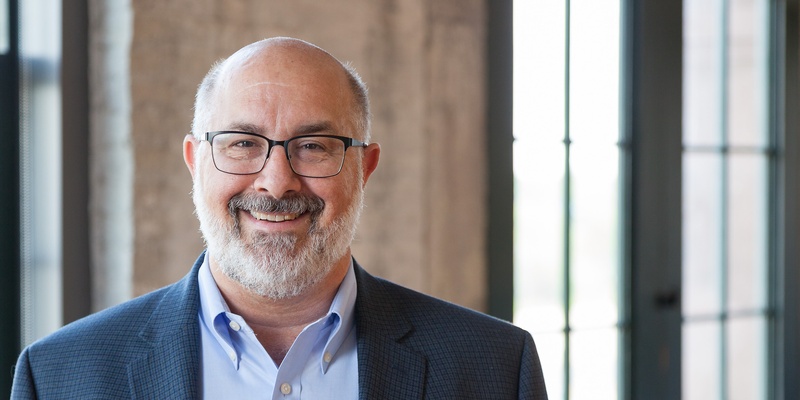
Photo courtesy of JCJ Architecture
Scott Celella
President, JCJ Architecture
Age: 67
Industry experience: 30 years
Specializing in education, hospitality and gaming projects has insulated JCJ Architecture from some of the downturns in commercial real estate sectors in recent years, enabling it to grow through a series of acquisitions across the U.S. The Hartford-based firm recently completed a leadership and succession transition with the promotion of Scott Celella, its longtime chief operating officer, to president. Celella succeeds Peter Stevens, who became principal and president emeritus on June 30. The firm now has 170 employees at seven U.S. offices including Las Vegas, where its design for the 1 October Memorial was adopted by county commissioners in 2022 to memorialize the victims of the 2017 mass shooting at a music festival on the Las Vegas Strip.
Q: Does JCJ plan additional acquisitions in the near future, and which regions would make sense to fill in the gaps?
A: There’s tons of potential. For it, it’s all about diversification geographically, or in terms of project type. One of those two needs to happen. Somewhat ancillary is if there’s something that looks completely different: that kind of need to bring in something new is the reason to pursue acquisitions. It’s all about positioning for growth and building on our strengths. We’ve got a very long history in education, and we have an excellent background in hospitality, gaming, hotels and food and beverage. One of the things we’ve looked for, for instance, is hotels on college campuses. We’ve had a chance to do three or four of those, and it leads up to things like multifamily housing, or a hospitality sensibility that can be introduced into a different type of venue. What we are looking for now is: what is the plug and play? What we’ll look for is the strength of the firm. If that firm has done a good job planting seeds or establishing some level of supremacy within a geographic area, they become more attractive to us. We can start to work with them immediately.
Q: What does the level of interest in hotel designs tell you about the imminent amount of development activity, specifically in New England?
A: I don’t know. One of the reasons is: it tends to move so fast. When 2020 hit, hospitality disappeared. Then at the beginning of 2021 for some reason which I don’t think any of us has been able to figure out, there was an immediate desire to finance hotels. We ended up with a huge hotel backsurge in 2021. In this local area, it’s going to be opportunities for boutique hotels. Here in New England, we’re looking forward to the reuse and rejuvenation of buildings: that redevelopment aspect. Some of our recent wins have played into that where there’s some building that’s been on the historic registry and there’s a chance to reconfigure it in a hotel. Or an abandoned office building for a hotel or housing mix. We’re doing two right now, in Maine and in the District of Columbia.
Q: Which practice areas have seen the most growth by property category in recent years?
A: Certainly hospitality has come back quite a bit. Education I think has been a little slower to get back into gear. It’s dictated by the funding levels. For the municipalities, there is a little bit more hesitation, and the colleges are struggling a bit.
Q: What about expansion opportunities into new property categories such as multifamily?
A: It’s an expansion strategy for us. We’re moving as a nation toward a more accepting attitude toward renting. I don’t think that American dream to own a home is as widespread as it used to be. We’re looking for lifestyle, workplace, convenience, in-home working: the whole sense of what housing has become and what it is in relation to the community has changed a bit. That gives way to multi-use, bringing in retail and understanding how those spaces interact. We have that baseline expertise. Every time we do an integrated resort we have to make those considerations.
Q: What’s the labor market like in architecture now, and what are JCJ’s biggest needs in talent acquisition in terms of job title and geography?
A: Like everything else, it’s uncertain right now. It was difficult to find talent as we’ve come out of COVID, and it’s loosening a bit now. Our retention and recruitment policy is always the same: we basically look very carefully at the kind of needs we have for the projects we have, and try to maintain a balance of people who are skilled in design, skilled in documentation and skilled in interior design. Our teams are really integrated, so we don’t have departments. We bring the professionals together into a team that’s producing for the client. That helps us with retention, because the team is involved. The leadership is doing what they do best. We have a corporate structure that’s oversight, but not directive. That’s healthy for us. We also have an Employee Stock Ownership Plan, and that sense of ownership is subtle but palpable.
Q: What is JCJ’s policy on remote work?
A: We’ve always had a flexible policy. As a subset is a hybrid work style, where we like to have people mostly in the office, three or four days a week, once people have been here three months and get the feel of the offices.
Q: What prompted JCJ’s interest in participating in the memorial design for the 2017 Las Vegas mass shooting?
A: We have an office in Vegas and an extremely talented group of folks there. The impact on the town was much stronger than it was conveyed in the media. Everyone felt they knew someone who was there and felt they needed to have a remembrance. We heard about it and immediately wanted to embrace it. And a big part of the practice is community. There was an initial design competition, so we worked quickly to develop a concept. It drew upon different aspects of other memorials. And as we were selected on the strength of that initial concept, it moved into in-depth interactions with survivors and family members who had lost people. The desire of those groups came into our design to make sure we were doing as comprehensive a memory as we could. Remembering the music, remembering the individuals and what they were to their community, and shaving a place where people could pause and reflect. The major walkway is a figure eight. There’s an area there which has 58 pillars, to talk about the 58 victims that happened. There was a need to be quiet, so there is a big change in the elevation, something like the Vietnam memorial. It’s undergoing some review and some budget issues which we actually worked to fix with them, and just kind of waiting for some decisions. But the design aspect is certainly in pretty good shape.
Q: How does the firm’s community engagement statement reflect its relationship with communities including Hartford?
A: Schools are the strongest one, obviously. The John F. Kennedy Middle School [in Enfield] was abandoned for a long time, and we went in and infused new life into it. It’s quite stunning. Some of the structure had been neglected, and we pulled it apart and reimagined the spaces and it’s quite vibrant and a jewel for the educational community right now. When people say, “Go design something,” we have a little bit of trouble, because our whole philosophy is about trying to help and give people to use. We don’t ensign monuments, or models or magic? We do buildings that people work in, live in and hopefully enhance their lives with. Our mission statement is design to build, not design for the sake of things.
Celella’s Five Favorite Ice Cream Flavors:
- Cherry Garcia
- Butter Pecan
- Coffee Almond Fudge
- Rum Raisin
- Black Raspberry

