




Photo courtesy of WInnCompanies
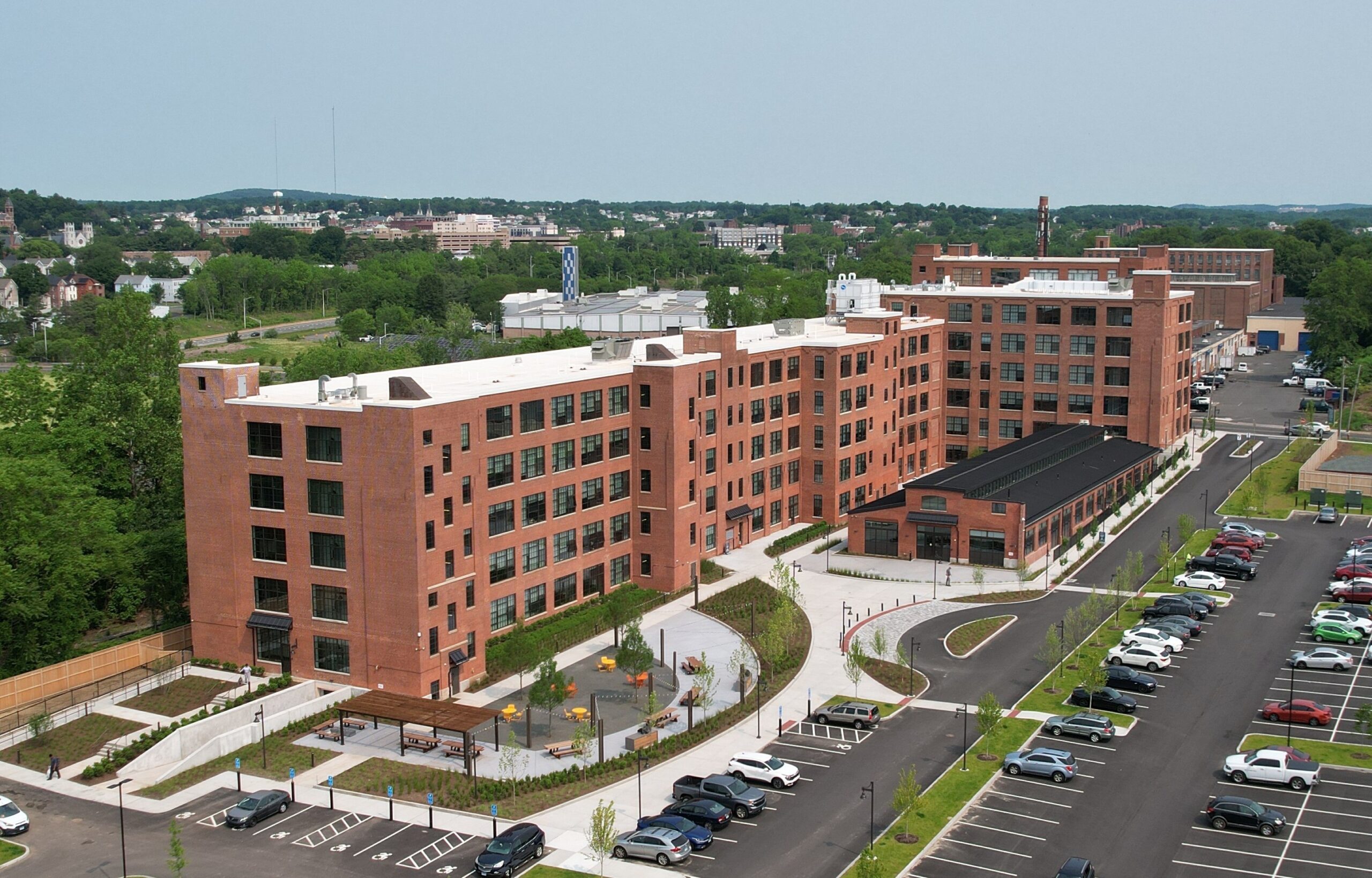
Connecticut Gov. Ned Lamont and New Britain Mayor Erin Stewart joined WinnCompanies executives this week to celebrate the opening of an $85 million project that transformed a historic long-vacant manufacturing complex near New Britain’s downtown into 154 units of affordable rental housing.
The adaptive reuse project converted four buildings in the 115-year-old Landers, Frary & Clark plant into 79 one-bedroom, 59 two-bedroom and 16 three-bedroom apartments geared toward young professionals, middle-income households and fixed-income seniors. The apartments serve individuals and families earning 30, 50, 60 and 80 percent of Area Median Income.
“As we stand here today, all but four apartments are already occupied in this community, underscoring the strong demand for quality, affordable and workforce housing in New Britain,” WinnDevelopment Executive Vice President Adam Stein said in a statement. “We thank state and local officials, as well as our private funders, for partnering with us to transform this historic remnant of the city’s industrial past into a modern apartment community that will serve working households well into the future.”
The city of New Britain provided a fixed tax assessment and local HOME Funds to support the development. Almost $8 million in funding was provided by the Connecticut Department of Housing, adding to the $44 million already invested in affordable housing for the city of New Britain over the last six years.
The Connecticut Housing Finance Authority (CHFA) provided tax credits, tax-exempt bonds and Opportunity Funds for the project. And Eversource purchased the $15 million state historic tax credits involved in the development, which also features rooftop solar arrays. Federal historic preservation tax credits were also used.
“To see one of our city’s most recognizable manufacturing buildings transformed into a beautiful housing option for those of varying income levels is truly a special moment for me as Mayor of this community,” Stewart said in a statement. “These apartments will significantly uplift the quality of life for those who live here while at the same time re-envisioning a long-underutilized building and improving the quality of the surrounding neighborhoods.”
Listed on the National Register of Historic Places in 2022, the property was once home to Landers, Frary & Clark, one of the first manufacturers of electric appliances in the United States, including the popular “Universal” brand of appliances, as well as percolators, irons, and waffle irons. During both World Wars, production swiftly shifted from houseware to military items, including gun mounts during World War II. The company ended production in 1965, and the property remained mostly vacant for decades.
Connecticut’s top housing officials also attended the ribbon cutting at the 6-story, 225,000-square-foot complex now known as The Ellis Block.
“All our housing projects are critical and drive our mission forward, however, this project is special in its unique history and agency collaboration,” Connecticut Housing Commissioner Seila Mosquera-Bruno said in a statement. “The more we can preserve our historic buildings and re-adapt them for residents to live in and raise their families in, the better. This is an exciting project, near public transportation, in a great location. We look forward to investing in more adaptive reuse so our families can afford to live and stay in Connecticut.”
Resident amenities include a fitness room, community room, game room, flex workspaces, outdoor seating areas, 230 parking spaces, and on-site leasing, maintenance, and management offices. The Ellis Block is located a mile from New Britain’s downtown and CTfastrak mass transit services.
Bank of America provided a construction loan and more than half of the project’s funding through its investment in the federal low-income housing and historic tax credits.
“Financing projects like Ellis Block aligns with our purpose of helping to build strong communities where we live and work through affordable housing and economic development,” Joe Gianni, Bank of America’s Greater Hartford president, said in a statement. “This project in a historic manufacturing complex in New Britain is an example of how private-public partnerships support our vibrant neighborhoods.”
BlueHub Capital, a non-profit community development financing organization based in Boston, provided a bridge loan for the project. The Connecticut Department of Economic and Community Development provided a Brownfield Loan to support environmental remediation work at the site.
Keith Construction, of Massachusetts acted as general contractor, with JCJ Architecture of Hartford as the architect and the Public Archaeology League as historic consultant.

