





Image courtesy of Newman Architects and Dattner Architechts
After a logistical hiccup earlier this month, New Haven city planning officials have given the green light to a 541-unit, two-block development across the street from the city’s Metro-North and Amtrak station.
The New Haven City Plan Commission this week approved the first phase of the planned 2,490-unit, 5.5-acre Union Square development just south of the city’s downtown after speakers at a public hearing expressed significant support for the effort to build housing on a huge, empty parcel that’s been likened to the city’s “front door.”
The project is being brought by The Glendower Group, the development arm of the city’s housing authority, Elm City Communities, and will include a substantial number of affordable housing units alongside market-rate ones. The mix has not yet been set.
The project’s first phase now has City Plan Commission approval, and gained the necessary rezoning approval from the local equivalent of a city council, the Board of Alders, on Monday.
The buildings approved this week include a block-sized, mid-rise podium development holding 354 apartments, half of another similar development and a public plaza connecting them. The later building will have its podium and around half its upper floors build in this phase, for a total of 196 apartments, with a subsequent phase in the 6-part project filling out the rest with a taller arm fully enclosing the building’s courtyard.
Each building will have one level of underground parking and one level of above-ground parking, wrapped by retail space, tenant amenities and townhouse units.
One of the project’s goals is to replace the 301 units of privately-owned affordable housing in the former Church Street South apartment complex, demolished some years ago after a long legal fight between tenants alleging health problems from the building and its owner. Elm City Communities bought the site in 2023 for $21 million and since then has been holding community engagement sessions to plan its project, funded by a grand from the federal Department of Housing and Urban Development.
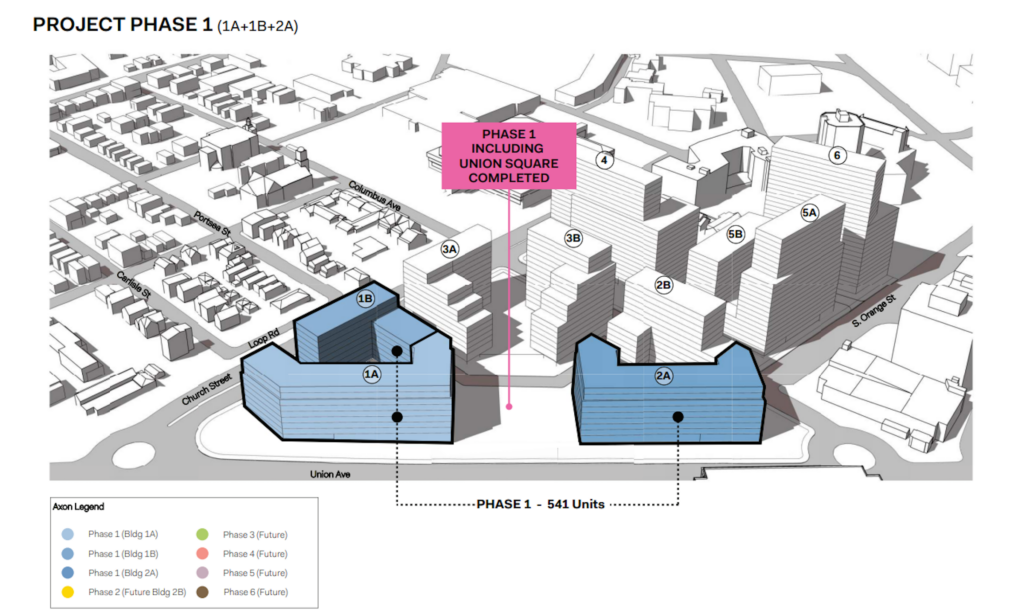
Image courtesy of Newman Architects and Dattner Architechts

