




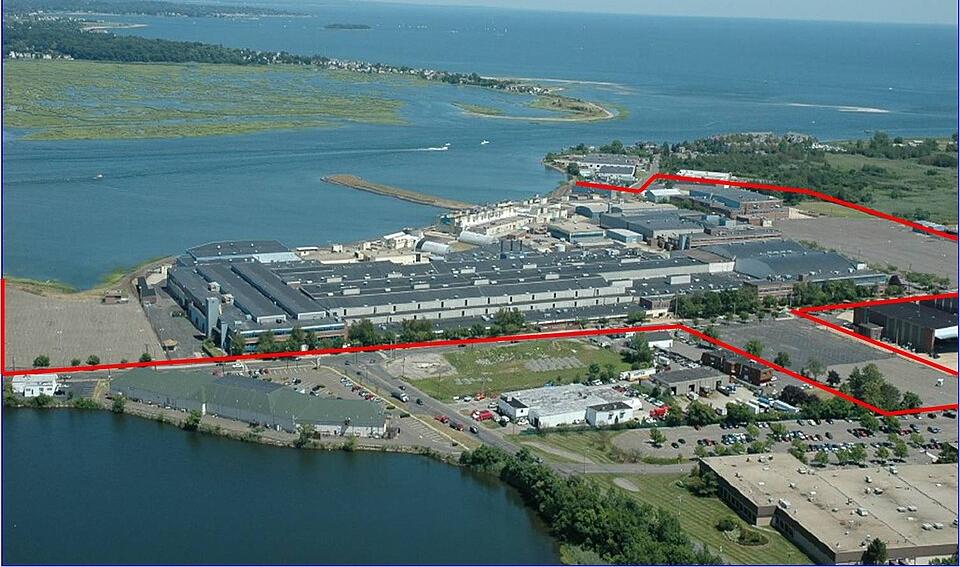
An aerial view of the 77-acre former Stratford Army Engine Plant property, which is being prepared for redevelopment by a Greenwich developer. Image courtesy of U.S. General Services Administration
Largely deserted for decades, the former Stratford Army Engine Plant property near Long Island Sound was a stubborn symbol of wasted potential to Dr. David Chess.
A former internist and newcomer to local politics, Chess was elected mayor of this Fairfield County town of 52,000 in November. He made one of his top priorities pressing a Greenwich-based developer for changes in their industrial-focused reuse plan for the site, currently known as Point Stratford.
“There’s not a lot of sites in Fairfield County that have 77 acres of waterfront property,” Chess said in an interview. “I strongly encouraged them to change course from warehouses to mixed-use development.”
Developer Point Stratford Renewal (PSR) said last month that it has hired architects Corgan as master planner and Field Operations as landscape architect as it rethinks its strategy for the site. The developers released an online survey to gauge public sentiment on the future of the property, and a public meeting is scheduled for June 29 to receive public comment.
PSR had previously marketed the site through brokerage CBRE for development of three industrial buildings totaling up to 1.1 million square feet.
Field Operations’ work includes New York City’s High Line and WS Development’s Seaport mixed-use development in Boston.
“Stratford’s former Army Engine Plant represents a once-in-a-generation opportunity to reconnect with the Housatonic River waterfront and create a magnificent cultural destination,” Field Operations CEO James Corner said in a statement.
Cabrera, whose Eagle Ventures company is active in a wide range of commercial projects, did not respond to requests for an interview with The Commercial Record. In a previously released statement, Cabrera said the goal is to create a “vibrant and economically sustainable development that honors its natural context, historical legacy and that integrates seamlessly with the surrounding community.”
Site Prep Clears Way for Construction
The Stratford property has a long history of military and defense uses. Originally developed by Sikorsky Aero Engineering Corp. in the 1920s, its final incarnation as the Stratford Army Engine Plant concluded in 1998. The U.S. Army named PSR as the redeveloper in 2012.
In recent years, developers have spent approximately $85 million on site preparation, including an environmental cleanup of the tidal flats that is expected to be completed within weeks, Chess said.
Developers also will be required to elevate the site, located in a flood zone, to protect buildings and infrastructure from elevated sea levels.
A conference center with waterfront views could become a regional destination, Chess said. Commercial uses could include high-tech manufacturing.

Steve Adams
Chess said housing production should also be an element of the project. The town’s 2023 Plan of Conservation & Development estimated construction of 420 housing units would enable Stratford to reach the 10 percent affordable housing goal set by the state and achieve safe harbor under 8-30g, the state law that enables housing developers to override local zoning regulations. But the town has little vacant land suitable for housing development, the Plan of Conservation & Development noted.
Eagle Ventures’ experience at the Harbor Point project in Stamford, another industrial waterfront site that was repurposed for offices and housing, indicates they have the ability to succeed in Stratford, Chess said.
He hopes that will translate in up to $40 million in new tax revenues for the town over the next decade at Point Stratford, helping offset the tax burden on the residential sector.
“I came to this [political career] more out of frustration, watching Stratford just not move forward,” he said.

