




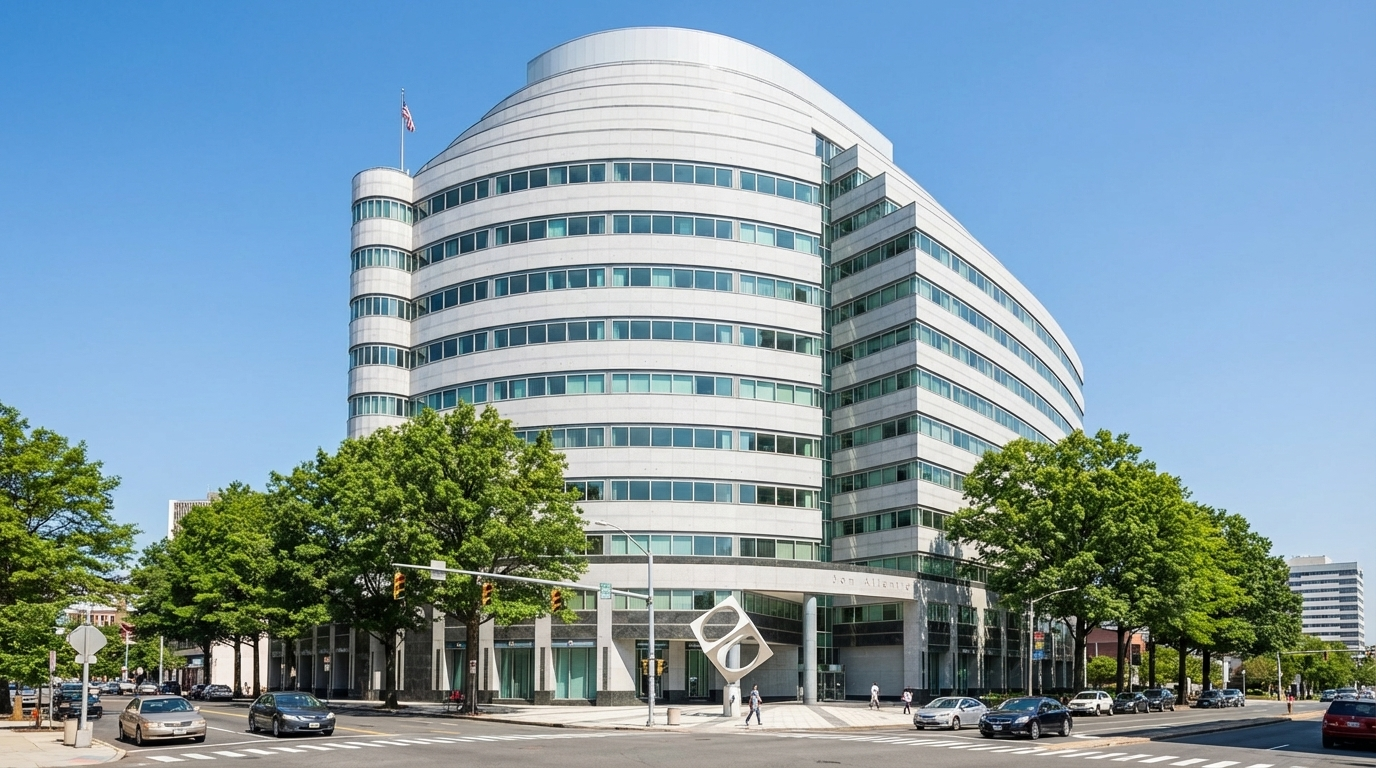
Office leasing activity in Fairfield County continues to gravitate toward central business district properties with proximity to transit, such as RFR’s 300 Atlantic St. in downtown Stamford. Photo courtesy of CBRE
Lenders are playing a significant role in selecting office tenants as substantial vacancies linger in Fairfield County’s office market.
Owners of properties that have tripped up mortgage covenants due to high vacancy or insufficient income have another layer of oversight, brokers say. Lenders want to make sure they rent to companies that are positioned for the long haul.
“It’s the credit-worthiness of the tenant,” said John Hannigan, a principal at Choyce Peterson in Norwalk. “They typically like to see companies that have been in business at least three to five years, and they are profitable.”
With a growing roster of office properties at risk of mortgage defaults, lenders also are looking closely at tenant improvement allowances and free rent that brokers and landlords use to lure new tenants, Hannigan said.
Tom Pajolek, executive vice president at CBRE in Stamford, agreed that credit-worthiness of tenants is paramount.
“They are interested in the financial viability of the tenants,” Pajolek said. “Tenant improvements are expensive, and free rent is money you are not collecting for a period of time. There is a real focus on credit and term.”
The inventory of distressed and lender-controlled properties could rise without a reversal of the post-pandemic downturn in leasing.
The latest data from CBRE shows negative absorption year-to-date in five of Fairfield County’s seven submarkets. The vacancy rate declined slightly to 24.4 percent countywide, ranging from a low of 9 percent in downtown Greenwich to nearly 28 percent in Stamford’s non-central business district submarket.
In a survey of 90 larger Class A office buildings, Choyce Peterson found the higher-end buildings totaling 16.4 million square feet have a 28 percent availability rate.
Wave of Corporate Relocations Expected
As long-term leases signed just before or after COVID in 2020 expire, companies continue to take advantage of the tenant-friendly market conditions.
“We’re going to see another two or three years of leases expiring and the potential for companies to downsize and relocate to higher-quality buildings than they are in now,” Choyce Peterson’s Hannigan said. “We’re going to see companies moving within lower Fairfield County, and we anticipate that the vacancy rate is not going to significantly move up or down.”
Among 24 buildings in Greenwich, availabilities rose from 13.7 percent at the end of 2025 to 20.2 percent, according to Choyce Peterson, the highest level since the end of 2021. The uptick is partially tied to the expiration of Blue Sky Studios’ 150,000-square-foot lease at 1 American Lane, following the animation studio’s closure in 2021.
Westport’s 21-building class A market has remained more stable, with vacancies rising from 11.9 to 12.4 percent in the past six months.
Class A properties retained their advantages during the early stages of the post-pandemic period, as companies took advantage of rising availabilities to upgrade to higher space. In the second quarter, class A properties captured 90 percent of leasing volume, led by Stamford’s central business district, according to CBRE.
But across the county, the class A and B markets now have narrowing vacancy rates at 23 and 22 percent, respectively.
Well-amenitized and centrally-located properties such as RFR’s 1 million-square-foot Stamford Plaza continue to generate leasing momentum. The four-building complex includes a 2.5-acre plaza with putting green and bocce court, and RFR recently updated the lobbies in the 3 and 4 Stamford Plaza buildings.
Those perks have helped it attract and retain tenants in a range of industries from financial services to life sciences, consumer goods and media.
Among the new tenants is the property’s leasing broker, CBRE, which opened its new 9,050 square-foot offices this week in a relocation from 201 Tresser Boulevard.
“The transit-oriented areas in the CBD’s are getting a lot of love from the owners, in the form of amenities and capital improvements, if they have the financial wherewithal to put it together,” CBRE’s Pajolek said

