




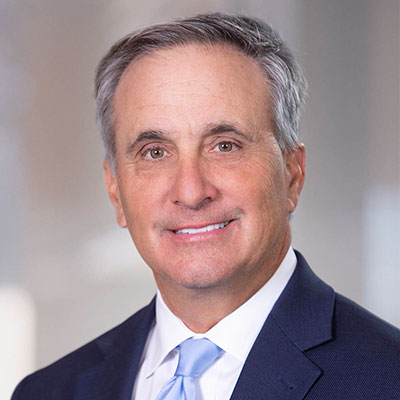
Photo courtesy of PeoplesBank
Tom Senecal
President and CEO, PeoplesBank
Industry experience: 35 years
PeoplesBank, chairman and CEO Tom Senecal announced that he will retire at the end of 2025. Senecal was elected president, CEO and chairman of the bank in 2016.
The banking veteran led the Holyoke, Massachusetts-based mutual bank through a period of significant expansion, including a holding company merger with Cornerstone Bank and the acquisition of Connecticut-based First National Bank of Suffield. The bank also launched a national digital bank and secured the naming rights for the PeoplesBank Arena in Hartford.
With his time at PeoplesBank nearing its end, Senecal and his team embarked on the latest phase in what’s been a career-long innovative journey. The bank’s core and processing platform is now on the cloud thanks to a partnership with Nimbus. Ahead of his retirement, Senecal still reflects on how much technology has changed the banking landscape.
Q: What stood out when you first started working for the bank?
A: I had worked for KPMG for nine years, and said, “I’d love to go work for a bank.” I picked PeoplesBank because I really thought they were a really good bank at the time. I think they still are. What really stood out to me is my impression in 1995 that technology was much more prevalent than reality, and when I got into the bank in 1995, I realized, “Oh, my God!” I worked in the finance area and we used to type checks on a typewriter, and put the check in an envelope, and then type on the envelope when we had to pay the bank’s bills. When I got in the bank and I saw that, I was like, “You got to be kidding me.” I thought there’s got to be some automated system. That was the beginning of automation, so to speak, and where we are today is just light years ahead of where the industry and PeoplesBank was in ’95.
Q: What has been the biggest technological advancement in banking?
A: It’s online. Payment systems are entirely digital, and access and transfer of money is just so fast and so immediate. There’s non-bank competitors in all those fields. Look at Apple. Look at Apple Pay. Look at Venmo. Look at all these payment systems that are not banks, but provide the same services that banks provide. ATMs are not quite obsolete but they’re not as readily used as they once were. You don’t hear or see too many banks putting in ATMs. Actually we put in ITM’s, which are interactive teller machines, and they’re more video-oriented as a supplement to our branch network. Some other banks have taken the strategy of eliminating branches and putting in ATMs in close markets, geographically. For example, banks may have had branches in one town east, and they’re eliminating some towns and putting an ATM and saying, “Look, we don’t need to have a branch there anymore. We can just put an ATM or ITM in,” because people don’t go into branches as much anymore. They literally only go into branches when they have problems, when they have questions, when they want to do an application, but they are doing payments or withdrawals or deposits less and less . You can do all that with your phone. You don’t have to go into a branch.
Q: What do you think has allowed for PeoplesBank to have this successful, sustained growth?
A: So when we announced the [holding company] merger with Cornerstone Bank – they’re in Western Mass. and Northern Connecticut – we agreed that we both want to grow south to Connecticut and east towards Boston. We will continue to look for opportunities in the M&A space either direction, but in the meantime, we will continue our organic growth in both those markets. We have an enormous amount of our commercial business for probably the last 15 years out of Connecticut. We’ve only been in Connecticut with our retail footprint for seven years, so we have been pushed by our commercial base in Connecticut to start opening branches, and we did that about eight years ago with our acquisition of First National Bank of Southfield.
We believe our naming rights on the Hartford New PeoplesBank Arena is a step in the direction to differentiate ourselves in the Connecticut market. People’s United Bank is gone. They’re acquired by M&T. There’s confusion in the marketplace and we’re trying to get the message out of who we are as a mutual institution, not a [publicly-traded] institution, with local decision making, with community involvement that is not quite prevalent in the Connecticut market. Massachusetts has way more mutual banks than Connecticut does, and with some of the Connecticut mutuals going public or gone. We think there’s an opportunity for us to compete at our size, at around the $7 billion level that that will enable us to do larger deals and also be that local decision making.
We’ve grown in Connecticut, as I mentioned, commercially, probably 60 percent of our commercial portfolio from word of mouth. We don’t do commercial advertising in the Connecticut market, but I have heard several times from our customers that they just really like doing business with us. The one reason they like it is we make decisions upfront. We don’t string our commercial customers along. We’re pretty good at saying “We’ll do the deal, these are the deal terms and conditions,” and we stick to our commitment. Cornerstone Bank has the exact same culture, I think that that culture helps, especially with commercial businesses, who need certainty and they need commitment, and they don’t want to be strung along. I think that is what differentiates us in that marketplace.
Yes, we will continue in the Mass. market to look for M&A opportunities with similar type cultures that want to stay mutual and the same thing in Connecticut. We continue to talk to other banks, and a lot of other banks, even smaller ones, believe that they can exist at their size. I’m not sure I agree with that. I think it’s hard to exist at that size. As you see, our costs escalate enormously. If you don’t grow, you can’t afford things. I think they’ll slowly start to realize that over the future.
Q: Looking back, whether it’s an initiative, a change or something else, what was the biggest thing that PeoplesBank was able to achieve in your time there?
A: I’m going to expand on a little bit on our partnership with Nimbus [a cloud-based core provider]. Seven years ago we started talking about it. Five years ago, we committed to it. It’s taken us five years to build this core system and that’s not to say it didn’t come with any bumps and bruises – it did – but it came through the way we wanted it to. The intuitiveness, the ease of it, is all worth what we went through.
We had seven full time people committed to this core conversion. Seven plus 40 people from Nimbus committed over the last five years. It’s an enormous resource commitment to do this. I probably would have retired earlier, but I’ve been holding off because of this, and I’m glad I did. I’m glad we saw it through. We’re still not finished. I will say that we converted in June, and we still have some things we have to iron out, but I can see the short-term pain for long-term gain. I can just see the benefits that will be coming from this well into the future.
I’ve been told by several other bank presidents, “Why the heck would you do this at your age?” I said, “If I don’t do it, no one will.” Being a lame duck, all your decisions as a lame duck can be made, because there’s no ramifications. Could it have been a career-threatening move if it didn’t go so well? Yes, it could have been. So I’m really proud of the fact that we came through with it, and I’m glad I can say to my competitors and the naysayers in the marketplace that we couldn’t do it, that we absolutely did. So I’m pretty proud of that.
Senecal’s Five Favorite Golf Courses
- Augusta National
- Pine Valley
- Pebble Beach
- Old Sandwich
- Shinnecock

