




Image courtesy of Partnership for Strong Communities
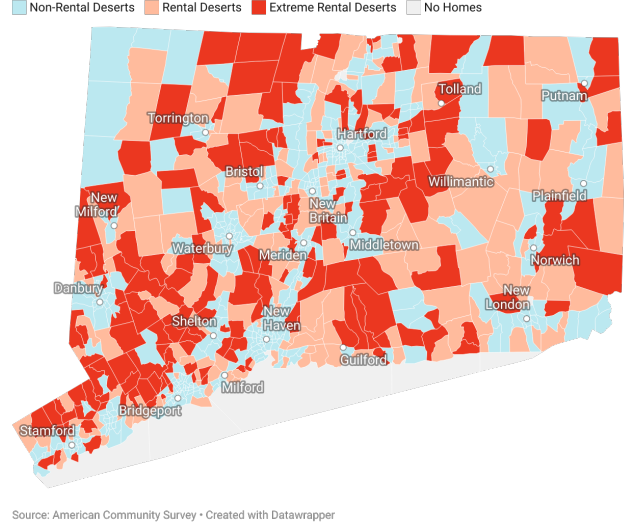
A recent uptick in multifamily development has cut into decades of stagnant activity, but rental deserts remain in many Connecticut communities and restrict housing options for residents.
The Hartford-based Partnership for Strong Communities released its inaugural report this month on the state of Connecticut’s housing market. It notes that over 90 percent of the state’s land area is zoned for single-family homes, while only 2.2 percent is zoned for multifamily projects with four or more units.
“Housing costs are far too out of reach for far too many people across incomes, tenures and communities,” PSC Executive Director Chelsea Ross said during a presentation on the report last week.
The report defines “rental deserts” as neighborhoods in which fewer than 20 percent of housing stock consists of rental units, and “extreme rental deserts” as those with fewer than 10 percent.
Overall, 33 percent of Connecticut’s housing stock consists of rentals.
While nearly two-thirds of the state’s housing stock consists of single-family homes, recent development trends have shifted toward a larger multifamily component.
Single-family homes’ share of new construction activity has declined from 87 percent of new construction to 29 percent since 2000, the study notes.
At the same time, larger-scale multifamily construction has accelerated.
“Multifamily development – particularly homes that include affordable options – helps slow rent growth in surrounding neighborhoods. Upzoning, transit-oriented development, and other policy changes that promote more efficient use of land allocated for housing would be the most significant for ensuring long-term affordability,” the report states.
Report Recommends Zoning Reform
To continue that momentum, the report recommends statewide zoning reform eliminating barriers to multifamily development, such as reductions in parking minimums and minimum lot size requirements. Communities that rezone for dense housing near transportation hubs should be given priority in receiving discretionary state infrastructure grants, it added.
In 2021, Massachusetts’ MBTA Communities law required 177 communities to rezone for multifamily development near transit service or lose access to discretionary state funding. The law has catalyzed nearly 7,000 housing units proposed or under construction.
But in Connecticut, statewide zoning reforms such as reduced parking requirements failed to gain legislative support. One landmark bill that gained passage required all 369 communities to draw up their own housing production plans.
The state added nearly 6,000 housing units in 2024, but 80 percent of the activity was located in Hartford, New Haven and Fairfield counties.
Developers seeking to build apartments in areas with single-family zoning can pursue approvals through Section 8-30g, the state affordable housing zoning law. But construction permitted through the law is unevenly distributed throughout the state, the report found.
Acute needs remain for extremely low-income housing, defined as households earning a maximum 30 percent of area median income, with an estimated shortfall of nearly 64,000 homes. The report recommends that an additional $370 million be allocated through Connecticut’s FLEX program and Housing Trust Fund to subsidize development.
Housing Vouchers ‘Provide Immediate Relief’
The federal Housing Choice Voucher program, commonly known as Section 8, supports approximately 42,000 lower-income households in Connecticut and guarantees they pay a maximum 30 percent of income on rent. The program is augmented by Connecticut’s state-funded rental assistance program, which services approximately 6,400 households.
“Increasing our financial investment in the rental assistance program is one of the few solutions we have that will provide immediate relief to families,” Ross said.
Gov. Ned Lamont, appearing at a conference to unveil the report’s findings, pointed to the administration’s support of transit-oriented development in Naugatuck as a model for future housing development.
“You have more population, more growth and more housing in that part of the state than ever before. I’d like to use that as a template for what I do going forward,” Lamont said.

