




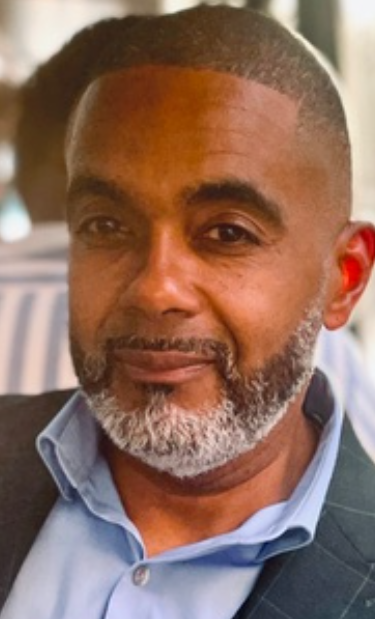
Photo courtesy of The Cloud Company
Anthony Healis Sr.
Principal, The Cloud Company
Age: 50
Industry experience: 17 years
The Cloud Co. is turning former state office buildings into 104 downtown Hartford apartments and reshaping a former public housing complex as a mixed-income community. Through a series of partnerships with national developer Pennrose, the Hartford development firm also is active in transit-oriented development projects including a three-phase, 180-unit rental project in downtown Naugatuck that broke ground last fall. The two companies have developed over 700 apartments in mixed-income communities across Connecticut in just over a decade. In 2009, former Hartford fire Capt. Anthony Healis joined the firm, which was founded by his cousin Sanford Cloud Jr., as a senior project manager. Healis was named a principal in 2020.
Q: What is The Cloud Company’s business model?
A: We pursue multifamily housing development, mostly affordable housing and mixed-income. We partner with [Pennrose] and we’ve done approximately 700 units of mixed-income rentals in the state of Connecticut. Our philosophy and our business models align. We look to do transformational development, which to date has mostly been in Connecticut’s urban centers. Given that not all of the 169 municipalities in Connecticut are urban centers, we have branched out to smaller communities that have identified a need of affordable housing options for their respective communities. We have projects completed in Torrington and Meriden and one underway in Naugatuck. While most of the projects are classified as transit-oriented developments, we have a few such as the Village at Park River in Hartford that are outside of TOD. The Village at Park River is a former Housing Authority-run site that had met its end of useful life, and they were looking for a development partner. The public housing has been taken down, and what we have now is mostly townhome-style units that are mixed income, with a wide swath of affordability. We’ve completed seven phases of rentals, and we have a swath of 10 acres of land that we’re going to do commercial retail. That’s the next phase. There’s also a small parcel we are preserving for home ownership if funding arises.
Q: Are there any public subsidies for affordable home ownership projects?
A: At the moment, there are limited to no subsidies for doing home ownership units at this time. Any that do exist simply aren’t robust enough to cover the cost of construction. That is one of the biggest hurdles: the cost of constructing these units. Unfortunately in Hartford, you have a market that doesn’t necessarily cover the cost of the units. As an example, if it’s $350,000 or more to construct and the sale price for the market is roughly $250,000, there’s about a $100,000 if not more gap that needs to be covered per unit. And that’s hard costs only.
Q: What recent hard cost escalation have you seen because of tariffs?
A: The main driver was COVID. Things went up, and they have never come back down: appliances, steel, wood, light weight metals and plastics used in construction rose to historic rates. We are still working with our prime contractor to see what we can do to control costs as much as possible. Tariffs add an additional layer of costs, and so do the fact there’s an increase in interest rates and insurance costs. The low-income housing tax credits [also called LIHTCs] that we rely heavily on in the capital stack of our projects, no longer go as far as they used to. We have to figure out other sources of financing. When I first got started, you’d get the LIHTCs and couple them with one or two additional funding sources. Now it’s the LIHTCs plus eight to 10 other sources, if not more that’s needed.
Q: How is the progress on your office to residential conversion on Trinity Street in Hartford?
A: It’s coming along. Right now we are finished with all the abatement and remediation work. We’ve done the select demolition. We’re in the construction and adaptation phase. Both buildings are being worked on simultaneously with our general contractor and all of their subs, and it’s been an interesting process to date to convert two historic former state office buildings that will play a pivotal role in transforming the Bushnell South neighborhood.
Q: Have you encountered any surprises during the work?
A: There’s always some unknowns you’ll find in converting historic structures. On the second floor of 30 Trinity St, we uncovered a beautiful brick archway that had been covered up. No one knew it was there until we started dismantling the buildings, so we worked to quickly change some of our design elements so that the archway could be incorporated into the floor plan, and to make sure it can be seen and viewed, as it was originally part of the building.
Q: What do office conversion projects need in terms of subsidies?
A: The historic element adds a different cost layer you normally wouldn’t have to contend with, but being able to tap into the historic tax credits to supplement LIHTCs was important in getting this project to pencil. Office buildings are unique in that they typically have the infrastructure: the water, sewer, gas and electrical services are usually robust enough to convert these over fairly easily. Those things make it a little easier, but you’re contending with floor plates that don’t necessarily support the configuration or number of living units you need to make the project work. So it takes creativity and ingenuity of our architects, engineers, consultants and contractors to figure out how to make it work. There’s no one-size-fits-all solution, and these types of projects can easily require millions of dollars in subsidies to bring them to fruition.
Q: Is your downtown Naugatuck housing development in partnership with Pennrose on schedule for a fall opening, and what’s next in the pipeline?
A: We are just about 45 percent complete with phase one in Naugatuck. The second phase is in the final stages of design and financing, and phase three should enter design soon after phase two is awarded, which we are hopeful of receiving notification of this spring. Beyond that, we have a funding request in for a project in New Haven, which is the Horace Strong School, another historic adaptive reuse project. We are also pursuing a multi-phase project in Torrington.
Healis’ Five Favorite Classic Cars
- 1970-1972 Chevy Chevelle SS
- 1968 Chevy II Nova
- 1968-1970 Plymouth Road Runner
- 1969 Pontiac GTO Judge
- 1970 Dodge Charger R/T

